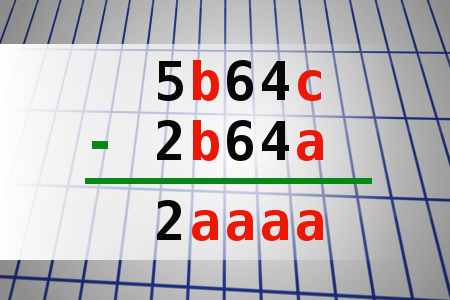
Find number abc
[7408] Find number abc - If 5b64c - 2b64a = 2aaaa find number abc. Multiple solutions may exist. - #brainteasers #math - Correct Answers: 6
BRAIN TEASERS
enter your answer and press button OK

Find number abc

If 5b64c - 2b64a = 2aaaa find number abc. Multiple solutions may exist.
Correct answers: 6
#brainteasers #math
Register with your Google Account and start collecting points.
Check your ranking on list.

That Darn Cat

A man who absolutely hated his wife's cat decided to get rid of him one day by driving him 20 blocks from his home and leaving him at the park.
As he was nearing home, the cat was walking up the driveway.
The next day, he decided to drive the cat 40 blocks away and try the same thing.
As we was driving back into his driveway, there was the cat! He kept taking the cat farther and farther away, but the darn cat would always beat him home.
At last, he decided to drive a few miles away, turn right, then left, past the bridge, then right again and another right and so on until he reached what he thought was a safe distance from his home and he left the cat there.
Hours later, the man calls home to his wife: "Jen, is the cat there?"
"Yes," the wife answers. "Why do you ask?"
Frustrated, the man answers: "Put that damn cat on the phone. I'm lost and I need directions!"      

Jokes of the day - Daily updated jokes. New jokes every day.
Follow Brain Teasers on social networks

Brain Teasers

puzzles, riddles, mathematical problems, mastermind, cinemania...

Moon radar

In 1946, the U.S. Army Project Diana team detected radar signals reflected off the moon's surface. A 180 cycle wave pulse with a 1/4 sec duration was beamed by the Army Signal Corps from the Evans Signal Laboratories, Belmar, N.J. The echo was received 2.4 sec. later, proving that radio waves could penetrate Earth's atmosphere. The experiment was supervised by Lt. Col. John H. De Witt, the broadcasting pioneer and amateur astronomer who first came up with the idea in 1940. His early amateur attempts were unsuccessful, but his chance came a few years later, after WW II, courtesy of the U.S. Army, at the Signal Corps Laboratories. During the war, he had developed radar for locating mortars and directing counterfire.«[Image: A wartime SCR-271 bedspring radar antenna, greatly modified for use in the experiment.]
This site uses cookies to store information on your computer. Some are essential to help the site properly. Others give us insight into how the site is used and help us to optimize the user experience. See our privacy policy.