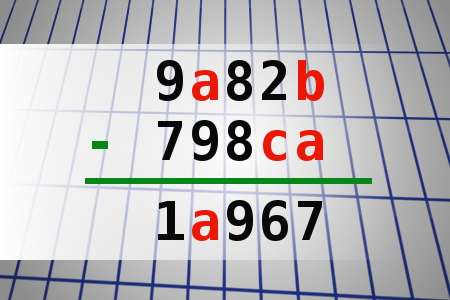
Find number abc
[7509] Find number abc - If 9a82b - 798ca = 1a967 find number abc. Multiple solutions may exist. - #brainteasers #math - Correct Answers: 3
BRAIN TEASERS
enter your answer and press button OK

Find number abc

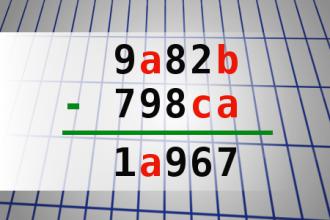
If 9a82b - 798ca = 1a967 find number abc. Multiple solutions may exist.
Correct answers: 3
#brainteasers #math
Register with your Google Account and start collecting points.
Check your ranking on list.

Sherlock Holmes and Dr. Watson

Sherlock Holmes and Dr. Watson go on a camping trip, set up their tent, and fall asleep.

Some hours later, Holmes wakes his faithful friend. "Watson, look up at the sky and tell me what you see."

Watson replies, "I see millions of stars."

"What does that tell you?"

Watson ponders for a minute. "Astronomically speaking, it tells me that there are millions of galaxies and potentially billions of planets. Astrologically, it tells me that Saturn is in Leo. Timewise, it appears to be approximately a quarter past three. Theologically, it's evident the Lord is all-powerful and we are small and insignificant. Meteorologically, it seems we will have a beautiful day tomorrow. What does it tell you?"

Holmes is silent for a moment, then speaks. "Watson, you idiot, someone has stolen our tent."

Jokes of the day - Daily updated jokes. New jokes every day.
Follow Brain Teasers on social networks

Brain Teasers

puzzles, riddles, mathematical problems, mastermind, cinemania...

Henry Fox Talbot

Born 11 Feb 1800; died 17 Sep 1877 at age 77.William Henry Fox Talbot was an English inventor, mathematician, chemist, physicist, philologist and Egyptologist who invented the negative-positive photographic process. He improved the discovery by Thomas Wedgwood (1802) that brushing silver nitrate solution onto paper produces a light-sensitive medium able to record negative images, but Wedgewood was unable to control the darkening. In February 1835, Talbot found that a strong solution of salt fixed the image. Using a camera obscura to focus an image onto his paper to produce a negative, then - by exposing a second sheet of paper to sunlight transmitted through the negative - he was the first to produce a positive picture of which he was able to make further copies at will. His Pencil of Nature (1844) was the first photographically illustrated book.
This site uses cookies to store information on your computer. Some are essential to help the site properly. Others give us insight into how the site is used and help us to optimize the user experience. See our privacy policy.