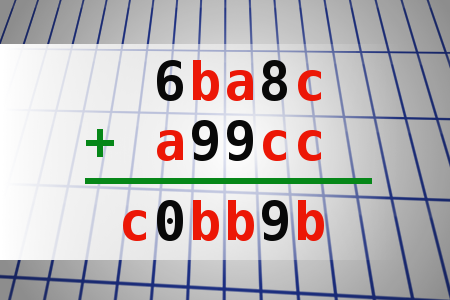
Find number abc
[7562] Find number abc - If 6ba8c + a99cc = c0bb9b find number abc. Multiple solutions may exist. - #brainteasers #math - Correct Answers: 5
BRAIN TEASERS
enter your answer and press button OK

Find number abc

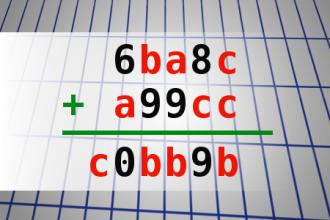
If 6ba8c + a99cc = c0bb9b find number abc. Multiple solutions may exist.
Correct answers: 5
#brainteasers #math
Register with your Google Account and start collecting points.
Check your ranking on list.

A rich man was trying to find...

A rich man was trying to find his daughter a birthday gift when he saw a poor man with a beautiful white horse. He told the man that he would give him $500 for the horse.
The poor man replied, "I don't know mister, it don't look so good," and walked away.
The next day the rich man came back and offered the poor man $1000 for the horse.
The poor man said, "I don't know mister, it don't look so good."
On the third day the rich man offered the poor man $2000 for the horse, and said he wouldn't take no for an answer. The poor man agreed, and the rich man took the horse home.
The rich man's daughter loved her present. She climbed onto the horse, then galloped right into a tree.
The rich man rushed back over to the poor man's house, demanding an explanation for the horse's blindness.
The poor man replied, "I told you. It don't look so good."
Jokes of the day - Daily updated jokes. New jokes every day.
Follow Brain Teasers on social networks

Brain Teasers

puzzles, riddles, mathematical problems, mastermind, cinemania...

Hermann von Helmholtz

Died 8 Sep 1894 at age 73 (born 31 Aug 1821). Hermann Ludwig Ferdinand von Helmholtz was a German physiologist and physicist who contribed much to physiology, optics, electrodynamics, mathematics, and meteorology, including the law of the conservation of energy (1847). He also developed thermodynamics, in particular introducing concept of free energy. In 1850, he measured the speed of a nerve impulse and, in 1851, invented the ophthalmoscope. He discovered the function of the cochlea in the inner ear and developed Thomas Young's theory of colour vision (published 1856). His study of muscle action led him to formulate a much more accurate theory concerning the conservation of energy than earlier proposed by Robert Mayer and James Joule.
This site uses cookies to store information on your computer. Some are essential to help the site properly. Others give us insight into how the site is used and help us to optimize the user experience. See our privacy policy.