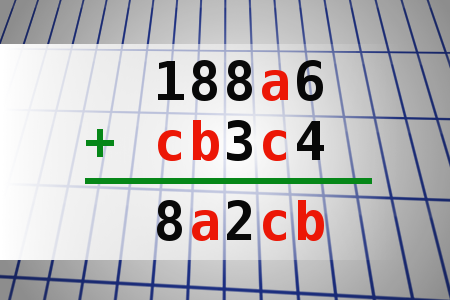
Find number abc
[7611] Find number abc - If 188a6 + cb3c4 = 8a2cb find number abc. Multiple solutions may exist. - #brainteasers #math - Correct Answers: 2
BRAIN TEASERS
enter your answer and press button OK

Find number abc

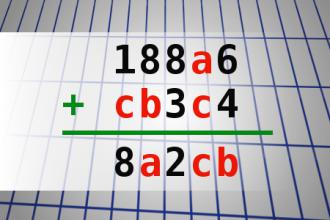
If 188a6 + cb3c4 = 8a2cb find number abc. Multiple solutions may exist.
Correct answers: 2
#brainteasers #math
Register with your Google Account and start collecting points.
Check your ranking on list.

The Healer

A semi-crippled Libertarian came into a bar and with difficulty, hoisted his bad leg over the bar stool, pulled himself up and asked for a sip of whiskey.

He looked down the bar and asked, "Is that Jesus down there?"

The bartender nodded and the Libertarian told him to give Jesus a whiskey also.

The next patron was an ailing Republican with a hunched back who moved slowly.

He shuffled up to the barstool and asked for a glass of wine. He also looked down the bar and asked if that was Jesus.

The bartender nodded and the Republican said to give Him a glass of wine also.

The third patron, a Democrat, swaggered in and said "Barkeep, give me a cold beer.

Hey, is that Jesus down there?"

The barkeep nodded, and the Democrat told him to give Jesus a cold one too.

As Jesus got up to leave, he walked over and touched the Libertarian and said, "For your kindness, you are healed!"

The Libertarian felt the strength come back to his leg, and he got up and danced a jig all the way to the door.

Jesus touched the republican and said, "For your kindness you are healed!"

The Republican felt his back straighten. He danced with joy and did a flip.

As Jesus walked toward the Democrat, the Democrat jumped back and exclaimed, "Don't touch me, I'm drawing disability!"

Jokes of the day - Daily updated jokes. New jokes every day.
Follow Brain Teasers on social networks

Brain Teasers

puzzles, riddles, mathematical problems, mastermind, cinemania...

Alfred Wolf

Died 17 Dec 1998 at age 75 (born 13 Feb 1923).Alfred Peter Wolf was an American nuclear and organic chemist. As a senior chemist at the U.S. Brookhaven National Laboratory, he made pioneering contributions over nearly 50 years in the field of organic radiochemistry. By the mid-1960's, his fundamental studies in the synthesis of small, radiolabeled compounds grew into a new interest in developing radiotracers labeled with short-lived positron emitting isotopes like carbon-11 so that the tracer method could be applied to visualize biochemical transformations in living systems. His discoveries led to advances in medical imaging, especially the development of positron emission tomography, or PET, a tool now used worldwide to diagnose disease and study the brain's inner workings.
This site uses cookies to store information on your computer. Some are essential to help the site properly. Others give us insight into how the site is used and help us to optimize the user experience. See our privacy policy.