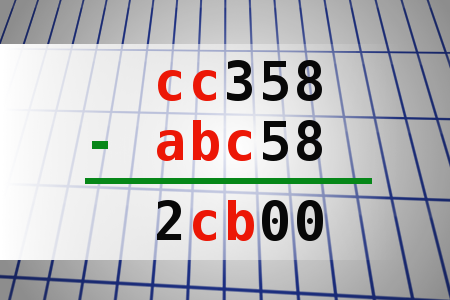
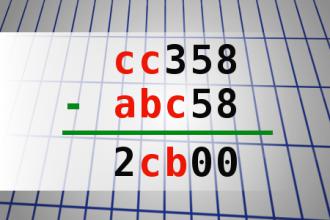
Find number abc
[7731] Find number abc - If cc358 - abc58 = 2cb00 find number abc. Multiple solutions may exist. - #brainteasers #math - Correct Answers: 1
BRAIN TEASERS
enter your answer and press button OK

Find number abc

If cc358 - abc58 = 2cb00 find number abc. Multiple solutions may exist.
Correct answers: 1
#brainteasers #math
Register with your Google Account and start collecting points.
Check your ranking on list.

The test

Two young engineers applied for a single position at a computer company.

They both had the same qualifications. In order to determine which individual to hire, the applicants were asked to take a test by the Department manager.

Upon completion of the test, both men missed only one of the questions.

The manager went to the first applicant and said, "Thank you for your interest, but we've decided to give the job to the other applicant."

"And why would you be doing that? We both got 9 questions correct," asked the rejected applicant.

"We have based our decision not on the correct answers, but on the question you missed," said the Department manager.

"And just how would one incorrect answer be better than the other?" the rejected applicant inquired.

"Simple," said the Department manager, "Your fellow applicant put down on question #5, 'I don't know.' You put down, 'Neither do I.'"

Jokes of the day - Daily updated jokes. New jokes every day.
Follow Brain Teasers on social networks

Brain Teasers

puzzles, riddles, mathematical problems, mastermind, cinemania...

Augustus De Morgan

Died 18 Mar 1871 at age 64 (born 27 Jun 1806). English mathematician and logician who did important work in abstract symbolic logic, the theory of relations, and formulated De Morgan's laws: one is “NOT (A AND B) = (NOT A) or (NOT B)” and the other is “NOT (A OR B) = (NOT A) AND (NOT B)”. These laws continue to be applied in modern proof theory and for software programming. When he defined and introduced the term “mathematical induction” (1838), he gave the process a rigorous basis and clarity that it had previously lacked. He originated the use of the slash to represent fractions, as in 1/5 or 3/7. In Trigonometry and Double Algebra (1849) he gave a geometric interpretation of complex numbers.«[Born in India, De Morgan (according to Macfarlane) De Morgan considered himself to be British, without being specifically English, Scottish, Welsh or Irish.]
This site uses cookies to store information on your computer. Some are essential to help the site properly. Others give us insight into how the site is used and help us to optimize the user experience. See our privacy policy.