Find number abc
[7798] Find number abc - If a4ab4 - 422c4 = 12310 find number abc. Multiple solutions may exist. - #brainteasers #math - Correct Answers: 12
BRAIN TEASERS
enter your answer and press button OK

Find number abc

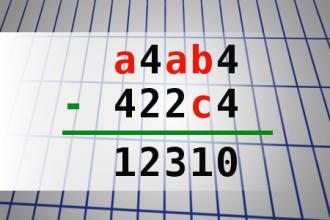
If a4ab4 - 422c4 = 12310 find number abc. Multiple solutions may exist.
Correct answers: 12
#brainteasers #math
Register with your Google Account and start collecting points.
Check your ranking on list.

Play Your Age

A lady is having a bad day at the roulette tables in ‘Vegas. She's down to her last $50. Exasperated, she exclaims,
“What rotten luck! What in the world should I do now?”
A man standing next to her, trying to calm her down, suggests,
“I don't know… why don't you play your age?”
He walks away. Moments later, his attention is grabbed by a great commotion at the roulette table. Thinking Maybe she'd won, he rushes back to the table and pushes his way through the crowd.
The lady is lying limp on the floor, with the table operator kneeling over her.
The man is stunned. He asks, “What happened? Is she all right?”

The operator replies, “I don't know. She put all her money on 29, and 36 came up. Then she just fainted!”

Jokes of the day - Daily updated jokes. New jokes every day.
Follow Brain Teasers on social networks

Brain Teasers

puzzles, riddles, mathematical problems, mastermind, cinemania...

Hans Albrecht Bethe

Died 6 Mar 2005 at age 98 (born 2 Jul 1906). German-American physicist who helped to shape classical physics into quantum physics and increased the understanding of the atomic processes responsible for the properties of matter and of the forces governing the structures of atomic nuclei. Bethe did work relating to armour penetration and the theory of shock waves of a projectile moving through air. He studied nuclear reactions and reaction cross sections (1935-38). In 1943, Robert Oppenheimer asked Bethe to be the head of the Theoretical Division at Los Alamos on the Manhattan Project. After returning to Cornell University in 1946, Bethe became a leader promoting the social responsibility of science. He received the Nobel Prize for Physics (1967) for his work on the production of energy in stars.
This site uses cookies to store information on your computer. Some are essential to help the site properly. Others give us insight into how the site is used and help us to optimize the user experience. See our privacy policy.