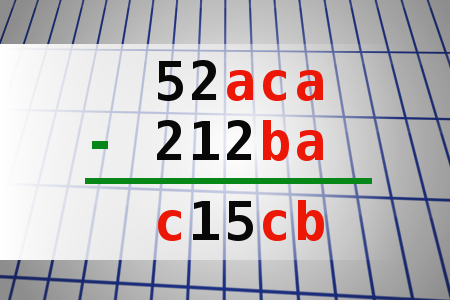
Find number abc
[7967] Find number abc - If 52aca - 212ba = c15cb find number abc. Multiple solutions may exist. - #brainteasers #math - Correct Answers: 1
BRAIN TEASERS
enter your answer and press button OK

Find number abc

If 52aca - 212ba = c15cb find number abc. Multiple solutions may exist.
Correct answers: 1
#brainteasers #math
Register with your Google Account and start collecting points.
Check your ranking on list.

National Geographic

Ole and Lena are 69-ing when Ole says, "Lena, did you know there are 117,000 musk ox in Alaska?"

Lena says, "No, I didn't."

Ole says, "And Lena, did you know there are 482,000 grizzly bears living in Alaska?"

Lena says, "No, I didn't. Gee, you're smart."

Ole says, "And Lena, did you know there are more than 2 million caribou living in Alaska?"

"No," says Lena, wondering how this conversation came about in the middle of their sex play.

"How did you get so smart?"

Ole says, "Remember last night when we ran out of toilet paper and had to use the pages out of magazines?"

"Yes, I remember," says Lena.

"Well, you still have page 63 of National Geographic stuck to your ass."

Jokes of the day - Daily updated jokes. New jokes every day.
Follow Brain Teasers on social networks

Brain Teasers

puzzles, riddles, mathematical problems, mastermind, cinemania...

Richard P. Feynman

Died 15 Feb 1988 at age 69 (born 11 May 1918). Richard Philips Feynman was an American theoretical physicist who was probably the most brilliant, influential, and iconoclastic figure in his field in the post-WW II era. By age 15, he had mastered calculus. He took every physics course at MIT. His lifelong interest was in subatomic physics. In 1942, he went to Los Alamos where Hans Bethe made the 24 year old Feynman a group leader in the theoretical division, to work on estimating how much uranium would be needed to achieve critical mass for the Manhattan (atomic bomb) Project. After the war, he developed Feynman Diagrams, a simple notation to describe the complex behavior of subatomic particles. In 1965, he shared (with Julian Schwinger and Shin-ichiro Tomonaga) the Nobel Prize in Physics for work in quantum electrodynamics.
This site uses cookies to store information on your computer. Some are essential to help the site properly. Others give us insight into how the site is used and help us to optimize the user experience. See our privacy policy.