Find number abc
[8020] Find number abc - If 3c8a6 + c660a = abc0c find number abc. Multiple solutions may exist. - #brainteasers #math - Correct Answers: 0
BRAIN TEASERS
enter your answer and press button OK

Find number abc

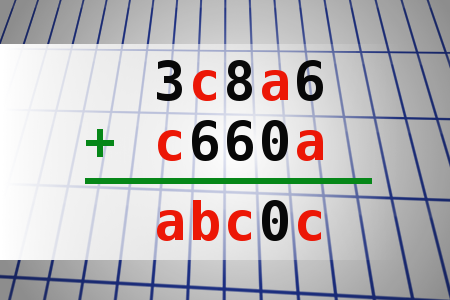
If 3c8a6 + c660a = abc0c find number abc. Multiple solutions may exist.
Correct answers: 0
#brainteasers #math
Register with your Google Account and start collecting points.
Check your ranking on list.

Why the sun lightens our hair...

Why the sun lightens our hair, but darkens our skin?
Why women can't put on mascara with their mouth closed?
Why you don't ever see the headline "Psychic Wins Lottery"?
Why "abbreviated" is such a long word?
Why doctors call what they do "practice"?
Why you have to click on "Start" to stop Windows XP?
Why lemon juice is made with artificial flavor, while dishwashing liquid is made with real lemons?
Why the man who invests all your money is called a broker?
Why there isn't mouse-flavored cat food?
Who tastes dog food when it has a "new & improved" flavor?
Why they sterilize the needle for lethal injections?
Why they don't make the whole plane out of the material used for the indestructible black box ?
Why sheep don't shrink when it rains?
Why they are called apartments when they are all stuck together?
If con is the opposite of pro, is Congress the opposite of progress?
Why they call the airport "the terminal" if flying is so safe?
Jokes of the day - Daily updated jokes. New jokes every day.
Follow Brain Teasers on social networks

Brain Teasers

puzzles, riddles, mathematical problems, mastermind, cinemania...

Norbert Wiener

Died 18 Mar 1964 at age 69 (born 26 Nov 1894). American mathematician who established the science of cybernetics, a term he coined, which is concerned with the common factors of control and communication in living organisms, automatic machines, and organizations. He attained international renown by formulating some of the most important contributions to mathematics in the 20th century. His work on generalised harmonic analysis and Tauberian theorems won the Bôcher Prize in 1933 when he received the prize from the American Mathematical Society for his memoir Tauberian theorems published in Annals of Mathematics in the previous year. His extraordinarily wide range of interests included stochastic processes, quantum theory and during WW II he worked on gunfire control.
This site uses cookies to store information on your computer. Some are essential to help the site properly. Others give us insight into how the site is used and help us to optimize the user experience. See our privacy policy.