Find number abc
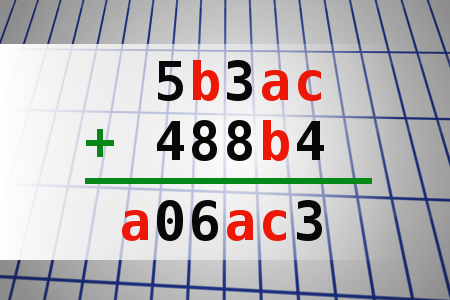
[8072] Find number abc - If 5b3ac + 488b4 = a06ac3 find number abc. Multiple solutions may exist. - #brainteasers #math - Correct Answers: 0
BRAIN TEASERS
enter your answer and press button OK

Find number abc

If 5b3ac + 488b4 = a06ac3 find number abc. Multiple solutions may exist.
Correct answers: 0
#brainteasers #math
Register with your Google Account and start collecting points.
Check your ranking on list.

From The Blonde Files

Jack, a handsome man, walked into a sports bar around 9:58 pm. He sat down next to this blonde at the bar and stared up at the TV...
The 10:00 news was on. The news crew was covering a story of a man on a ledge of a large building preparing to jump. The blonde looked at Jack and said, 'Do you think he'll jump?' Jack says, 'You know what, I bet he will.' The blonde replied, 'Well, I bet he won't.' Jack placed $30 on the bar and said, 'You're on!'
Just as the blonde placed her money on the bar, the guy did a swan dive off of the building, falling to his death. The blonde was very upset and handed her $30 to Jack, saying, 'Fair's fair... Here's your money.' Jack replied, 'I can't take your money, I saw this earlier on the 5 o'clock news and knew he would jump.
'The blonde replies, 'I did too; but I didn't think he'd do it again.' Jack took the money..

Jokes of the day - Daily updated jokes. New jokes every day.
Follow Brain Teasers on social networks

Brain Teasers

puzzles, riddles, mathematical problems, mastermind, cinemania...

Joseph Paxson Iddings

Born 21 Jan 1857; died 8 Sep 1920 at age 63.American geologist who advanced understanding in the field of petrology - the study of the origin, composition, structure, and alteration of rocks. Around 1880, he was one of the first in the U.S. to study thin rock sections with a microscope. He explored and mapped the geology of Yellowstone National Park during seven field seasons (1883-1890). From this study he introduced original ideas concerning the range of crystal line textures and mineral composition of granular igneous rocks. He proposed that physical and chemical conditions causing differences in the formationof neighbouring igneous rock from the same igneous magma. Further, he rejected the prevailing view that granular rocks were only formed in large masses at depth.«
This site uses cookies to store information on your computer. Some are essential to help the site properly. Others give us insight into how the site is used and help us to optimize the user experience. See our privacy policy.