Find number abc
[8202] Find number abc - If 48bc2 - cc99a = babca find number abc. Multiple solutions may exist. - #brainteasers #math - Correct Answers: 1
BRAIN TEASERS
enter your answer and press button OK

Find number abc

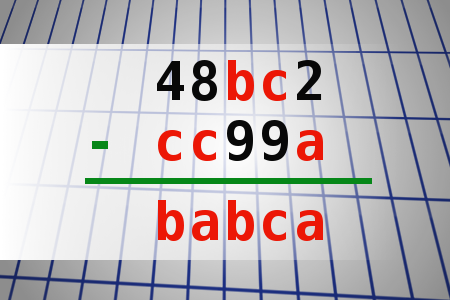
If 48bc2 - cc99a = babca find number abc. Multiple solutions may exist.
Correct answers: 1
#brainteasers #math
Register with your Google Account and start collecting points.
Check your ranking on list.

Normal sex life

When the good Lord was making the world, he called Man aside and bestowed upon him 20 years of normal sex life. Man was horrified, but the Creator refused to budge. Then the Lord called the Monkey and gave him 20 years.

"But I don't need 20 years," said the Monkey. "Ten years is plenty."

"May I have the other 10 years?" asked Man. The Monkey agreed.

The Lord called the Lion next and also gave him 20 good years. The Lion also only wanted 10, so again Man asked for the remaining ten. Then came the Donkey, who was also granted 20 years. Like the others, 10 was more than enough. Man again asked for the spare ten years and got them.

This explains why Man has 20 years of normal sex life, 10 years of monkeying around, 10 years of lion 'bout it, and 10 years of making an ass out of himself.

Jokes of the day - Daily updated jokes. New jokes every day.
Follow Brain Teasers on social networks

Brain Teasers

puzzles, riddles, mathematical problems, mastermind, cinemania...

Ernst Engel

Died 8 Dec 1896 at age 75 (born 26 Mar 1821). German statistician, the head of the Prussian Statistical Bureau (1860-82), known for the "Engel curve," or Engel's law, which states that the proportion of expenditure on food will fall as income rises, i.e. food is a necessary good. Engel's law applies to goods as a whole. Demand for food, clothing and shelter - and for most manufactured products - doesn't keep pace with increases in incomes. Engel curves are useful for separating the effect of income on demand from the effects of changes in relative prices. Engel also examined the relationship between the size of the Prussian rye harvest and the average price of rye over a number of years prior to 1860, probably the first empirical study of the relationship between price and supply.
This site uses cookies to store information on your computer. Some are essential to help the site properly. Others give us insight into how the site is used and help us to optimize the user experience. See our privacy policy.