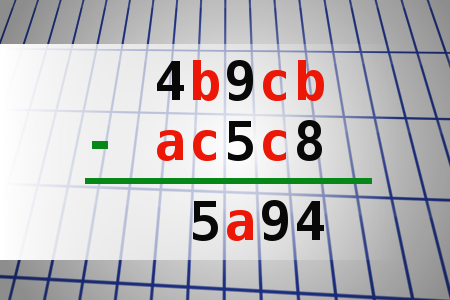
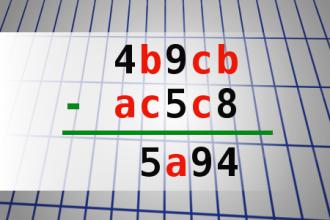
Find number abc
[8299] Find number abc - If 4b9cb - ac5c8 = 5a94 find number abc. Multiple solutions may exist. - #brainteasers #math - Correct Answers: 0
BRAIN TEASERS
enter your answer and press button OK

Find number abc

If 4b9cb - ac5c8 = 5a94 find number abc. Multiple solutions may exist.
Correct answers: 0
#brainteasers #math
Register with your Google Account and start collecting points.
Check your ranking on list.

Some people are good at being in love

Some people are good at being in love. Some people are good at love. Two very different things, I think. Being in love is the romantic part—sex all the time, midday naps in the sheets, the jokes, the laughs, the fun, long conversations with no pauses, overwhelming separation anxiety… Just the best sides of both people, you know? But love begins when the excitement of being in love starts to fade: the stress of life sets in, the butterflies disappear, the sex not so often, the tears, the sadness, the arguments, the cattiness; the worst parts of both people. But if you still want that person by your side through all of those things… that’s when you know—that’s when you know you’re good at love.
Jokes of the day - Daily updated jokes. New jokes every day.
Follow Brain Teasers on social networks

Brain Teasers

puzzles, riddles, mathematical problems, mastermind, cinemania...

Merle Antony Tuve

Born 27 Jun 1901; died 20 May 1982 at age 80.American research physicist and geophysicist who (with Gregory Breit) made the first use pulsed radio waves to explore the ionosphere. He devised the necessary detecting equipment to measure the time between receiving a direct radio pulse and a second pulse reflected from the ionosphere. The observations he made provided the theoretical foundation for the development of radar. Tuve, with Lawrence R. Hafstad and Norman P. Heydenburg, made the first and definitive measurements of the nuclear force between proton-proton force at nuclear distances. During WW II he developed the proximity fuse. Following the war, he made important contributions to experimental seismology, radio astronomy, and optical astronomy.«
This site uses cookies to store information on your computer. Some are essential to help the site properly. Others give us insight into how the site is used and help us to optimize the user experience. See our privacy policy.