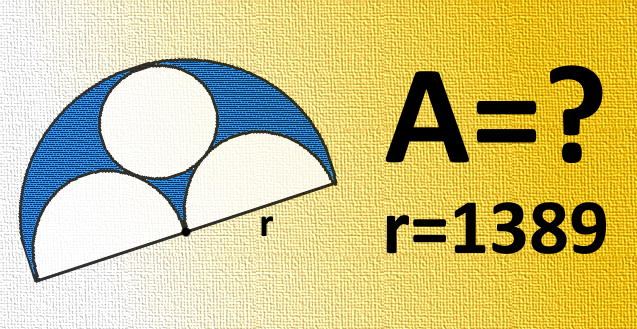
Find the area of the blue shaded region
[2543] Find the area of the blue shaded region - Find the area of the blue shaded region. Express result to the accuracy of 3 decimal. - #brainteasers #math - Correct Answers: 43 - The first user who solved this task is Roxana zavari
BRAIN TEASERS
enter your answer and press button OK

Find the area of the blue shaded region

Find the area of the blue shaded region. Express result to the accuracy of 3 decimal.
Correct answers: 43
The first user who solved this task is Roxana zavari.
#brainteasers #math

Register with your Google Account and start collecting points.
Check your ranking on list.

Lost boots

There was a little boy in kindergarten. At the end of one cold winter day, when all the other children were leaving, the teacher found him crying, so she asked him what was wrong.

He sobbed, "I can't find my boots."

The teacher looked around the classroom and saw a pair of boots. "Are these yours?"

"No, they're not mine," said the little boy, shaking his head.

The teacher and the boy searched all over the classroom for his boots.

Finally, the teacher gave up, "Are you SURE those boots are not yours?"

"I'm sure," the boy sobbed, "mine had snow on them."

Jokes of the day - Daily updated jokes. New jokes every day.
Follow Brain Teasers on social networks

Brain Teasers

puzzles, riddles, mathematical problems, mastermind, cinemania...

William Ferrel

Born 29 Jan 1817; died 18 Sep 1891 at age 74.American meteorologist who was an important contributor to the understanding of oceanic and atmospheric circulation. He was able to show the interrelation of the various forces upon the Earth's surface, such as gravity, rotation and friction. Ferrel was first to mathematically demonstrate the influence of the Earth's rotation on the presence of high and low pressure belts encircling the Earth, and on the deflection of air and water currents. The latter was a derivative of the effect theorized by Gustave de Coriolis in 1835, and became known as Ferrel's law. Ferrel also considered the effect that the gravitational pull of the Sun and Moon might have on the Earth's rotation and concluded (without proof, but correctly) that the Earth's axis wobbles a bit.
This site uses cookies to store information on your computer. Some are essential to help the site properly. Others give us insight into how the site is used and help us to optimize the user experience. See our privacy policy.