
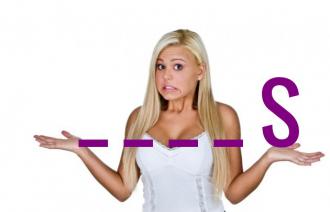
Find the missing text (****S...
[3308] Find the missing text (****S... - Find the missing text (****S). Background picture associated with the solution. - #brainteasers #wordpuzzles - Correct Answers: 21 - The first user who solved this task is Sanja Šabović
BRAIN TEASERS
enter your answer and press button OK

Find the missing text (****S...

Find the missing text (****S). Background picture associated with the solution.
Correct answers: 21
The first user who solved this task is Sanja Šabović.
#brainteasers #wordpuzzles
Register with your Google Account and start collecting points.
Check your ranking on list.

Getting tough

My grandfather worked in a blacksmith shop when he was a boy, and he used to tell me, when I was a little boy myself, how he had toughened himself up so he could stand the rigors of blacksmithing.

One story was how he had developed his arm and shoulders muscles. He said he would stand outside behind the house and, with a 5-pound potato sack in each hand, he would extend his arms straight out to his sides and hold them there as long as he could.

After awhile, he tried 10-pound potato sacks, then 50-pound potato sacks. Finally, he got to where he could lift a 100-pound potato sack in each hand and hold his arms straight out for more than a full minute!

Next, he started putting potatoes in the sacks.

Jokes of the day - Daily updated jokes. New jokes every day.
Follow Brain Teasers on social networks

Brain Teasers

puzzles, riddles, mathematical problems, mastermind, cinemania...

John Locke

Born 29 Aug 1632; died 28 Oct 1704 at age 72. English physician who was the most important philosopher during the Age of Reason. He spent over 20 years developing the ideas he published in most significant work, Essay Concerning Human Understanding (1690) which analysed the nature of human reason, and promoted experimentation as the basis of knowledge. He established primary qualities, (ex. solidity, extension, number) as distinct from secondary qualities identified by the sense organs (ex. colour, sound). Thus the world is otherwise silent and without colour. Locke recognised that science is made possible when the primary world mechanically affects the sense organs, thereby creating ideas that faithfully represent reality. He was an acquaintance of Robert Boyle.«
This site uses cookies to store information on your computer. Some are essential to help the site properly. Others give us insight into how the site is used and help us to optimize the user experience. See our privacy policy.