Find the right combination
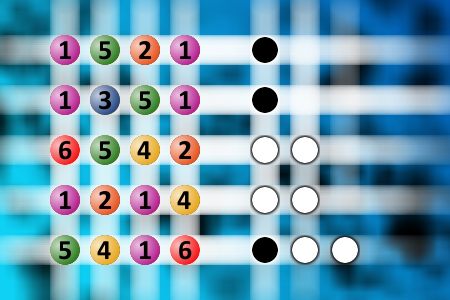
[2024] Find the right combination - The computer chose a secret code (sequence of 4 digits from 1 to 6). Your goal is to find that code. Black circles indicate the number of hits on the right spot. White circles indicate the number of hits on the wrong spot. - #brainteasers #mastermind - Correct Answers: 56 - The first user who solved this task is Djordje Timotijevic
BRAIN TEASERS
enter your answer and press button OK

Find the right combination

The computer chose a secret code (sequence of 4 digits from 1 to 6). Your goal is to find that code. Black circles indicate the number of hits on the right spot. White circles indicate the number of hits on the wrong spot.
Correct answers: 56
The first user who solved this task is Djordje Timotijevic.
#brainteasers #mastermind
Register with your Google Account and start collecting points.
Check your ranking on list.

Sex Researcher

This sex researcher phones one of the participants in a recent survey of his to check on a discrepancy. He asks the bloke, "In response to the question on frequency of intercourse you answered 'twice weekly'. Your wife, on the other hand, answered 'several times a night'."
"That's right," replies the bloke, "And that's how it's going to stay until our second mortgage is paid off."
Jokes of the day - Daily updated jokes. New jokes every day.
Follow Brain Teasers on social networks

Brain Teasers

puzzles, riddles, mathematical problems, mastermind, cinemania...

Antoni Zygmund

Died 30 May 1992 at age 91 (born 26 Dec 1900). Polish-American mathematician who created a major analysis research centre at Chicago, and recognized in 1986 for this with the National Medal for Science. In 1940, he escaped with his wife and son from German controlled Poland to the USA. He did much work in harmonic analysis, a statistical method for determining the amplitude and period of certain harmonic or wave components in a set of data with the aid of Fourier series. Such technique can be applied in various fields of science and technology, including natural phenomena such as sea tides. He also did major work in Fourier analysis and its application to partial differential equations. Zygmund's book Trigonometric Series (1935) is a classic, definitive work on the subject.«
This site uses cookies to store information on your computer. Some are essential to help the site properly. Others give us insight into how the site is used and help us to optimize the user experience. See our privacy policy.