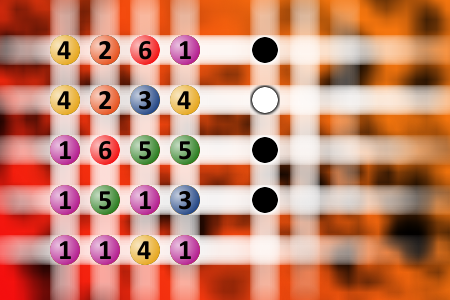
Find the right combination
[2886] Find the right combination - The computer chose a secret code (sequence of 4 digits from 1 to 6). Your goal is to find that code. Black circles indicate the number of hits on the right spot. White circles indicate the number of hits on the wrong spot. - #brainteasers #mastermind - Correct Answers: 78 - The first user who solved this task is On On Lunarbasil
BRAIN TEASERS
enter your answer and press button OK

Find the right combination

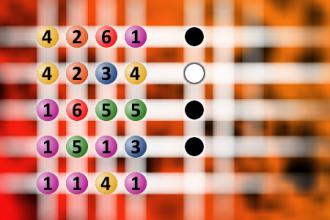
The computer chose a secret code (sequence of 4 digits from 1 to 6). Your goal is to find that code. Black circles indicate the number of hits on the right spot. White circles indicate the number of hits on the wrong spot.
Correct answers: 78
The first user who solved this task is On On Lunarbasil.
#brainteasers #mastermind
Register with your Google Account and start collecting points.
Check your ranking on list.

Two Sets of Tonsils?

A young man approached his family physician and said, "Doc, I'm afraid you'll have to remove my wife's tonsils one of these days."

"My good man," replied the doctor, "I removed them six years ago. Did you ever hear of a woman having two sets of tonsils?"

"No," the husband retorted, "but you've heard of a man having two wives, haven't you?"

Jokes of the day - Daily updated jokes. New jokes every day.
Follow Brain Teasers on social networks

Brain Teasers

puzzles, riddles, mathematical problems, mastermind, cinemania...

Complex Number Calculator operational

In 1940, George Stibitz's Complex Number Calculator was functional. He was a research mathematicianat Bell Laboratories, who worked on its construction from Apr 1939, assisted by Samuel Williams. Later known as Bell Labs Model I Relay Computer, it used telephone relays and coded decimal numbers as groups of four binary digits (bits) each. It has been called the first electromechanical computer for routine use. A demonstration of its ability in remote computing was given on 11 Sep 1940, when messages were exchanged by phone lines between teletypewriter operators. Calculations suggested by attendees of the American Mathematical Society's meeting at Dartmouth College, Hanover, New Hampshire were communicated to an attendant at the keyboard of Stibitz's calculator in New York.«
This site uses cookies to store information on your computer. Some are essential to help the site properly. Others give us insight into how the site is used and help us to optimize the user experience. See our privacy policy.