Find the right combination
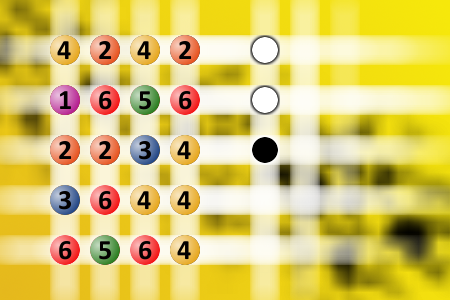
[3980] Find the right combination - The computer chose a secret code (sequence of 4 digits from 1 to 6). Your goal is to find that code. Black circles indicate the number of hits on the right spot. White circles indicate the number of hits on the wrong spot. - #brainteasers #mastermind - Correct Answers: 44 - The first user who solved this task is Djordje Timotijevic
BRAIN TEASERS
enter your answer and press button OK

Find the right combination

The computer chose a secret code (sequence of 4 digits from 1 to 6). Your goal is to find that code. Black circles indicate the number of hits on the right spot. White circles indicate the number of hits on the wrong spot.
Correct answers: 44
The first user who solved this task is Djordje Timotijevic.
#brainteasers #mastermind
Register with your Google Account and start collecting points.
Check your ranking on list.

Dad's turn to feed the baby....

The first-time dad was taking a turn at feeding the baby some strained peas. Naturally, there were traces of the food all over the baby.

His wife comes in, looks at the infant, then at her husband, who is just staring off into space and says, "What in the world are you doing?"

He replied, "I'm just waiting for the first coat to dry, so I can put on another."

Jokes of the day - Daily updated jokes. New jokes every day.
Follow Brain Teasers on social networks

Brain Teasers

puzzles, riddles, mathematical problems, mastermind, cinemania...

Carl Bosch

Died 26 Apr 1940 at age 65 (born 27 Aug 1874). German industrial chemist who at BASF directed development of the industrial scale process for production of ammonia from atmospheric nitrogen. In 1908, Fritz Haber, a professor of chemistry had suggested that nitrogen and hydrogen gases could be combined using high temperatures, high pressure and catalysts that resulted in the Haber-Bosch process. By 1910, Alwin Mittasch (1869-1953), head chemist of the BASF ammonia research laboratory identified activated iron as a suitable catalyst. Bosch supervised creation of new technical solutions for high pressure operations. He shared (with Friedrich Bergius) the 1931 Nobel Prize for Chemistry for devising chemical high-pressure methods.«
This site uses cookies to store information on your computer. Some are essential to help the site properly. Others give us insight into how the site is used and help us to optimize the user experience. See our privacy policy.