Find the right combination
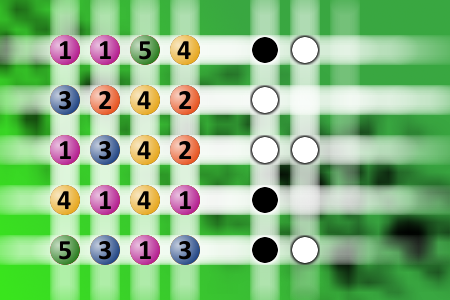
[4380] Find the right combination - The computer chose a secret code (sequence of 4 digits from 1 to 6). Your goal is to find that code. Black circles indicate the number of hits on the right spot. White circles indicate the number of hits on the wrong spot. - #brainteasers #mastermind - Correct Answers: 27 - The first user who solved this task is Manguexa Wagle
BRAIN TEASERS
enter your answer and press button OK

Find the right combination

The computer chose a secret code (sequence of 4 digits from 1 to 6). Your goal is to find that code. Black circles indicate the number of hits on the right spot. White circles indicate the number of hits on the wrong spot.
Correct answers: 27
The first user who solved this task is Manguexa Wagle.
#brainteasers #mastermind
Register with your Google Account and start collecting points.
Check your ranking on list.

One summer evening during a vi...

One summer evening during a violent thunderstorm a mother was tucking her small boy into bed. She was about to turn off the light when he asked with a tremor in his voice, "Mommy, will you sleep with me tonight?"
The mother smiled. "I can't dear," she said. 'I have to sleep in Daddy's room."
The little boy replied with a shaking voice, "The big sissy."
Jokes of the day - Daily updated jokes. New jokes every day.
Follow Brain Teasers on social networks

Brain Teasers

puzzles, riddles, mathematical problems, mastermind, cinemania...

Sir Fred Hoyle

Died 20 Aug 2001 at age 86 (born 24 Jun 1915). English astronomer and mathematician who is best known as the foremost proponent and defender of the steady-state theory of the universe. This theory holds both that the universe is expanding and that matter is being continuously created to keep the mean density of matter in space constant. He became Britain's best-known astronomer in 1950 with his broadcast lectures on The Nature of the Universe, and he recalled derisively coining the term “Big Bang” in the last of those talks. Although over time, belief in a “steady state” universe as Hoyle had proposed was shared by fewer and fewer scientists because of new discoveries, Hoyle never accepted the now most popular “Big Bang” theory for the origin of the universe.
This site uses cookies to store information on your computer. Some are essential to help the site properly. Others give us insight into how the site is used and help us to optimize the user experience. See our privacy policy.