Find the right combination
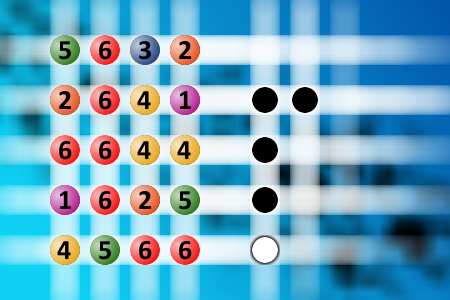
[4729] Find the right combination - The computer chose a secret code (sequence of 4 digits from 1 to 6). Your goal is to find that code. Black circles indicate the number of hits on the right spot. White circles indicate the number of hits on the wrong spot. - #brainteasers #mastermind - Correct Answers: 41 - The first user who solved this task is Djordje Timotijevic
BRAIN TEASERS
enter your answer and press button OK

Find the right combination

The computer chose a secret code (sequence of 4 digits from 1 to 6). Your goal is to find that code. Black circles indicate the number of hits on the right spot. White circles indicate the number of hits on the wrong spot.
Correct answers: 41
The first user who solved this task is Djordje Timotijevic.
#brainteasers #mastermind
Register with your Google Account and start collecting points.
Check your ranking on list.

An absent-minded husband thoug...

An absent-minded husband thought he had conquered his problem of trying to remember his wife's birthday and their anniversary.
He opened an account with a florist, provided that florist with the dates and instructions to send flowers to his wife on these dates along with an appropriate note signed, "Your loving husband."
His wife was thrilled by this new display of attention and all went well until one day, when he came home, kissed his wife and said offhandedly, "Nice flowers, honey. Where'd you get them?"
Jokes of the day - Daily updated jokes. New jokes every day.
Follow Brain Teasers on social networks

Brain Teasers

puzzles, riddles, mathematical problems, mastermind, cinemania...

Sir William Osler

Died 29 Dec 1919 at age 70 (born 12 Jul 1849). (Baronet) Canadian physician who revolutionized the medical curriculum in North America, adapting the best of the systems he had observed in England and Germany. He believed that students learn best by doing, teaching medical students at the bedside. He introduced postgraduate training system, instituting a general internship of one year to be followed by a residency of several years. His textbook, The Principles and Practice of Medicine (1892) included the advances of the previous half-century in clinical medical science, and remained the standard text for 40 years. Early in his life, in 1873, he made the most careful description to date of what later were called the "blood-platelets," which was presented to the Royal Society.«
This site uses cookies to store information on your computer. Some are essential to help the site properly. Others give us insight into how the site is used and help us to optimize the user experience. See our privacy policy.