Find the right combination
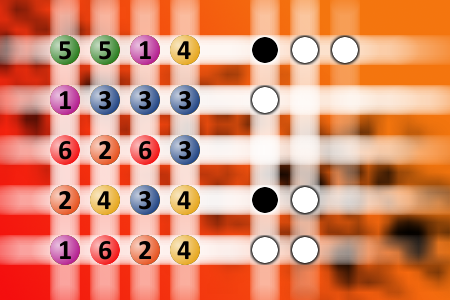
[4763] Find the right combination - The computer chose a secret code (sequence of 4 digits from 1 to 6). Your goal is to find that code. Black circles indicate the number of hits on the right spot. White circles indicate the number of hits on the wrong spot. - #brainteasers #mastermind - Correct Answers: 38 - The first user who solved this task is Djordje Timotijevic
BRAIN TEASERS
enter your answer and press button OK

Find the right combination

The computer chose a secret code (sequence of 4 digits from 1 to 6). Your goal is to find that code. Black circles indicate the number of hits on the right spot. White circles indicate the number of hits on the wrong spot.
Correct answers: 38
The first user who solved this task is Djordje Timotijevic.
#brainteasers #mastermind
Register with your Google Account and start collecting points.
Check your ranking on list.

The Old Nephew

My 7 year-old nephew showed me with pride the "telephone" he had just made from a string and two tin cans.
I pulled out my iPhone and said, "That's nice, but... look at the phones that kids your age are making in China!"

Jokes of the day - Daily updated jokes. New jokes every day.
Follow Brain Teasers on social networks

Brain Teasers

puzzles, riddles, mathematical problems, mastermind, cinemania...

L.E J. Brouwer

Died 2 Dec 1966 at age 85 (born 27 Feb 1881).Luitzen Egbertus Jan Brouwer was a Dutch mathematician who founded mathematical Intuitionism (a doctrine that views the nature of mathematics as mental constructions governed by self-evident laws). He founded modern topology by establishing, for example, the topological invariance of dimension and the fixpoint theorem. (Topology is the study of the most basic properties of geometric surfaces and configurations.) The Brouwer fixed point theorem is named in his honor. He proved the simplicial approximation theorem in the foundations of algebraic topology, which justifies the reduction to combinatorial terms, after sufficient subdivision of simplicial complexes, the treatment of general continuous mappings.
This site uses cookies to store information on your computer. Some are essential to help the site properly. Others give us insight into how the site is used and help us to optimize the user experience. See our privacy policy.