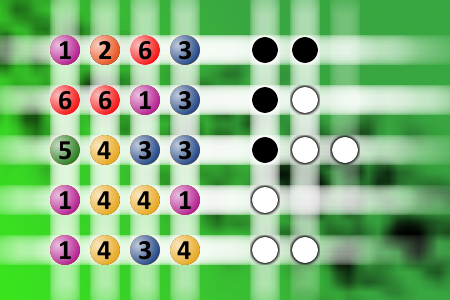
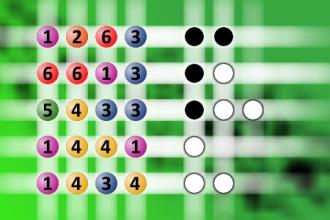
Find the right combination
[4912] Find the right combination - The computer chose a secret code (sequence of 4 digits from 1 to 6). Your goal is to find that code. Black circles indicate the number of hits on the right spot. White circles indicate the number of hits on the wrong spot. - #brainteasers #mastermind - Correct Answers: 35 - The first user who solved this task is Djordje Timotijevic
BRAIN TEASERS
enter your answer and press button OK

Find the right combination

The computer chose a secret code (sequence of 4 digits from 1 to 6). Your goal is to find that code. Black circles indicate the number of hits on the right spot. White circles indicate the number of hits on the wrong spot.
Correct answers: 35
The first user who solved this task is Djordje Timotijevic.
#brainteasers #mastermind
Register with your Google Account and start collecting points.
Check your ranking on list.

7 Funny short jokes to wake you up

We just watched the Tetris movie.
It's a blockbuster

My family is getting sick of me telling dad jokes 24/7.
Or should I say “they are sick of me telling dad jokes 3.428571428571429”?

When I was younger I had a job pretending to be a statue.
I held that position for some time.

The new thought-activated car they're working on is going to be even more popular than the voice-activated one.
It goes without saying.

My wife is one of the clumsiest people I know.
I'm so glad she fell for me

I have two questions about this Taylor Swift lady:
What kind of clothes does she make? And how fast does she make them, really?

I can’t think of a time when I lost my toupee while riding a motorcycle.
At least not right off the top of my head.

What do you call a 400 pound alcoholic?
A heavy drinker.

Jokes of the day - Daily updated jokes. New jokes every day.
Follow Brain Teasers on social networks

Brain Teasers

puzzles, riddles, mathematical problems, mastermind, cinemania...

Alexander Parkes

Born 29 Dec 1813; died 29 Jun 1890 at age 76.British industrial chemist who invented many processes. Parkes was an expert in electroplating, able to silver-plate such diverse objects as a spider web and flowers. He patented a method of rubber coating fabrics to waterproof them (1841), an electroplating process (1843), and a method of extracting silver from lead ore by adding zinc (1850). He produced the first plastic (1855), which he called Parkesine, by dissolving cellulose nitrate in alcohol and camphor containing ether. The hard solid result could be molded when heated, but he could find no market for the material. (This was rediscovered in the 1860s by John Wesley Hyatt, an American chemist, who named it celluloid and successfully marketed it as a replacement for ivory.«
This site uses cookies to store information on your computer. Some are essential to help the site properly. Others give us insight into how the site is used and help us to optimize the user experience. See our privacy policy.