Find the right combination
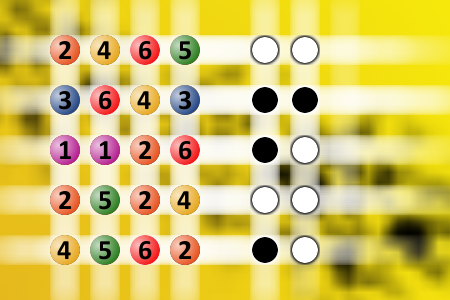
[5133] Find the right combination - The computer chose a secret code (sequence of 4 digits from 1 to 6). Your goal is to find that code. Black circles indicate the number of hits on the right spot. White circles indicate the number of hits on the wrong spot. - #brainteasers #mastermind - Correct Answers: 35 - The first user who solved this task is Alfa Omega
BRAIN TEASERS
enter your answer and press button OK

Find the right combination

The computer chose a secret code (sequence of 4 digits from 1 to 6). Your goal is to find that code. Black circles indicate the number of hits on the right spot. White circles indicate the number of hits on the wrong spot.
Correct answers: 35
The first user who solved this task is Alfa Omega.
#brainteasers #mastermind
Register with your Google Account and start collecting points.
Check your ranking on list.

Last year, when the power mowe...

Last year, when the power mower was broken and wouldn't run, I kept hinting to my husband that he ought to get it fixed, but somehow the message never sank in. Finally I thought of a clever way to make the point.
When my husband arrived home that day, he found me seated in the tall grass, busily snipping away with a tiny pair of sewing scissors.
He watched silently for a short time and then went into the house. He was gone only a few moments when he came out again. He handed me a toothbrush. "When you finish cutting the grass," he said, "you might as well sweep the sidewalks."
Jokes of the day - Daily updated jokes. New jokes every day.
Follow Brain Teasers on social networks

Brain Teasers

puzzles, riddles, mathematical problems, mastermind, cinemania...

John J. Bittner

Died 14 Dec 1961 at age 57 (born 25 Feb 1904).John J(oseph) Bittner was an American geneticist who isolated a "Bittner milk factor" (1949) from the milk of certain mice, which strongly suggested that at least some viruses can cause cancer. Using carefully bred strains of mice, he compared the role of the mother's genetic disposition to be either prone to cancer or resistant. By having the mice of one disposition act as foster mothers and nurse the babies of the other disposition, he showed that cancer-prone young could grow to be cancer resistant. The opposite was also true: babies originally cancer-resistant became cancer prone. He published this observation (1936), and went on to isolate particles of a virus-like size from the milk of cancer-prone mice that were not present in the milk of cancer-resistant mice.
This site uses cookies to store information on your computer. Some are essential to help the site properly. Others give us insight into how the site is used and help us to optimize the user experience. See our privacy policy.