Find the right combination
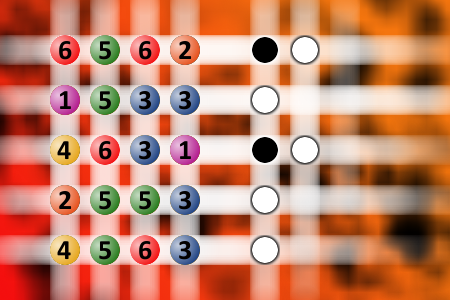
[5761] Find the right combination - The computer chose a secret code (sequence of 4 digits from 1 to 6). Your goal is to find that code. Black circles indicate the number of hits on the right spot. White circles indicate the number of hits on the wrong spot. - #brainteasers #mastermind - Correct Answers: 34 - The first user who solved this task is Nílton Corrêa De Sousa
BRAIN TEASERS
enter your answer and press button OK

Find the right combination

The computer chose a secret code (sequence of 4 digits from 1 to 6). Your goal is to find that code. Black circles indicate the number of hits on the right spot. White circles indicate the number of hits on the wrong spot.
Correct answers: 34
The first user who solved this task is Nílton Corrêa De Sousa.
#brainteasers #mastermind
Register with your Google Account and start collecting points.
Check your ranking on list.

Late for Work

Tom had this problem of getting up late in the morning and was always late for work. His boss was mad at him and threatened to fire him if he didn't do something about it. So Tom went to his doctor who gave him a pill and told him to take it before he went to bed.
Tom slept well and in fact beat the alarm in the morning. He had a leisurely breakfast and drove cheerfully to work. "Boss," he said, "The pill actually worked!"
"That's all fine" said the boss. "But where were you yesterday?"

Jokes of the day - Daily updated jokes. New jokes every day.
Follow Brain Teasers on social networks

Brain Teasers

puzzles, riddles, mathematical problems, mastermind, cinemania...

Bronislaw Malinowski

Died 16 May 1942 at age 58 (born 7 Apr 1884). Bronislaw Kasper Malinowski was a Polish-British anthropologist, one of the most important in the 20th century, who is widely recognized as the founder of social anthropology. He is principally associated with field studies of the peoples of Oceania. In 1914, on a research assignment to Australia, the outbreak of WW I kept him partially confined to the Trobriand Islands, off the eastern tip of New Guinea. In 1920, he returned to teaching in London, and in 1938 moved to teach in the U.S. He was the pioneer of “participant observation”as a method of fieldwork, used in his works on the Trobriand Islanders, especially Argonauts of the Western Pacific (1922) and Coral Gardens and their Magic (2 vols, 1935), which set new standards for ethnographic description.
This site uses cookies to store information on your computer. Some are essential to help the site properly. Others give us insight into how the site is used and help us to optimize the user experience. See our privacy policy.