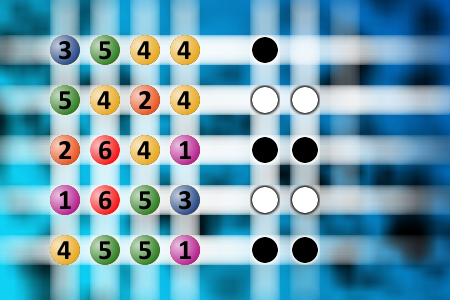
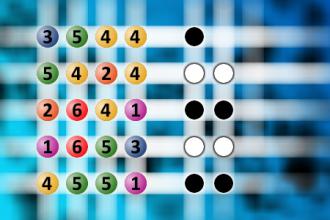
Find the right combination
[5967] Find the right combination - The computer chose a secret code (sequence of 4 digits from 1 to 6). Your goal is to find that code. Black circles indicate the number of hits on the right spot. White circles indicate the number of hits on the wrong spot. - #brainteasers #mastermind - Correct Answers: 34 - The first user who solved this task is Nasrin 24 T
BRAIN TEASERS
enter your answer and press button OK

Find the right combination

The computer chose a secret code (sequence of 4 digits from 1 to 6). Your goal is to find that code. Black circles indicate the number of hits on the right spot. White circles indicate the number of hits on the wrong spot.
Correct answers: 34
The first user who solved this task is Nasrin 24 T.
#brainteasers #mastermind
Register with your Google Account and start collecting points.
Check your ranking on list.

Friendship between wom...

Friendship between women: A woman doesn’t come home one night. The next day she tells her husband that she had slept over at a girlfriend's house.
The husband calls his wife's 10 best friends. None of them know anything about it.
Friendship between men: A man doesn’t come home one night. The next day he tells his wife that he had slept over at a friend’s house. The wife calls her husband's 10 best men friends. Eight of them confirm that he had slept over, and two claim that he was still there.
Jokes of the day - Daily updated jokes. New jokes every day.
Follow Brain Teasers on social networks

Brain Teasers

puzzles, riddles, mathematical problems, mastermind, cinemania...

Jerzy Neyman

Born 16 Apr 1894; died 5 Aug 1981 at age 87.Russian-American mathematician who was one of the principal architects of modern theoretical statistics. His papers on hypothesis testing (1928-33) helped establish the subject. During 1934-38, he gave a theory of confidence intervals (important in the analysis of data); extended statistical theory to contagious distributions, (for interpretation of biological data); wrote on sampling stratified populations (which led to such applications as the Gallup Poll); and developed the model for randomised experiments (widely relevant across the fields of science, including agriculture, biology, medicine, and physical sciences). His later research applied statistics to meteorology and medicine. In 1968 he was awarded the prestigious National Medal of Science.«
This site uses cookies to store information on your computer. Some are essential to help the site properly. Others give us insight into how the site is used and help us to optimize the user experience. See our privacy policy.