Find the right combination
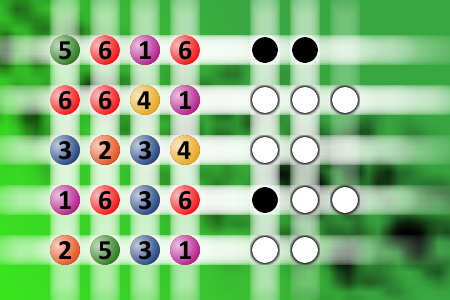
[6045] Find the right combination - The computer chose a secret code (sequence of 4 digits from 1 to 6). Your goal is to find that code. Black circles indicate the number of hits on the right spot. White circles indicate the number of hits on the wrong spot. - #brainteasers #mastermind - Correct Answers: 24 - The first user who solved this task is Nasrin 24 T
BRAIN TEASERS
enter your answer and press button OK

Find the right combination

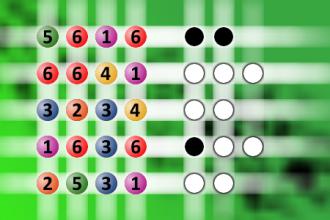
The computer chose a secret code (sequence of 4 digits from 1 to 6). Your goal is to find that code. Black circles indicate the number of hits on the right spot. White circles indicate the number of hits on the wrong spot.
Correct answers: 24
The first user who solved this task is Nasrin 24 T.
#brainteasers #mastermind
Register with your Google Account and start collecting points.
Check your ranking on list.

Sticky Hair?

Rabbit is hopping along the forest one day, when he comes upon Bear taking a dump.

Bear says, "Rabbit, do you have a problem with shit sticking to your fur?"

Rabbit replies, "No Bear, I don't. Why do you ask?"

So Bear grabs Rabbit and wipes his ass with him.

Jokes of the day - Daily updated jokes. New jokes every day.
Follow Brain Teasers on social networks

Brain Teasers

puzzles, riddles, mathematical problems, mastermind, cinemania...

Edison patent

In 1891, Thomas A. Edison was issued a U.S. patent for an innovation for a “Phonograph” (U.S. No. 453,741). The invention consisted of a “means for adjusting a phonograph reproducing-point into exact alignment with the phonogram-record” and also a “means for limiting the movement of the diaphragm which supports the recording and reproducing point when turned to place the reproducer” out of, or into, the operative position. The patent covered only modifications to improve upon the design of his phonograph on which he had previously filed for a patent on 18 Nov 1889 (issued as Patent No. 465,972 on 29 Dec 1891). That related patent for the machine itself was not the first he invented, but a description of a simplified construction. He had various previous patents on the phonograph and improvements.«
This site uses cookies to store information on your computer. Some are essential to help the site properly. Others give us insight into how the site is used and help us to optimize the user experience. See our privacy policy.