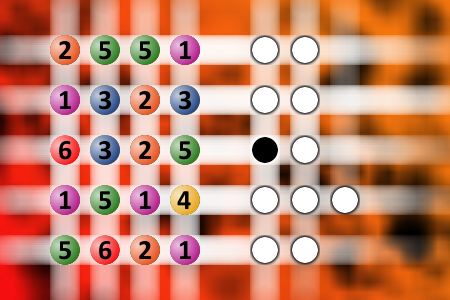
Find the right combination
[6539] Find the right combination - The computer chose a secret code (sequence of 4 digits from 1 to 6). Your goal is to find that code. Black circles indicate the number of hits on the right spot. White circles indicate the number of hits on the wrong spot. - #brainteasers #mastermind - Correct Answers: 28 - The first user who solved this task is Nasrin 24 T
BRAIN TEASERS
enter your answer and press button OK

Find the right combination

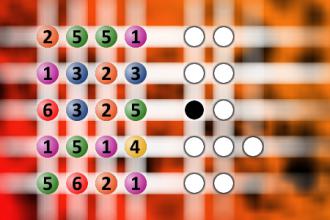
The computer chose a secret code (sequence of 4 digits from 1 to 6). Your goal is to find that code. Black circles indicate the number of hits on the right spot. White circles indicate the number of hits on the wrong spot.
Correct answers: 28
The first user who solved this task is Nasrin 24 T.
#brainteasers #mastermind
Register with your Google Account and start collecting points.
Check your ranking on list.

Who Wants to be a Millionaire

A contestant on "Who Wants to be a Millionaire" had reached the final plateau.If she answered the next question correctly, she would win$1,000,000. If she answered incorrectly, she would pocket only the $32,000 milestone money.As she suspected it would be, the million- dollar question was no pushover. It was: Which of the following species of birds does not build its own nest, but instead lays its eggs in the nests of other birds? Is it
A) the condor;
B) the buzzard;
C) the cuckoo; or
D) the vulture?"
The woman was on the spot. She did not know the answer. And she was doubly on the spot because she had used up her 50/50 Lifeline and her Audience Poll Lifeline. All that remained was her Phone-a-Friend Lifeline, and the woman had hoped against hope that she would not have to use it because the only friend that she knew would be home happened to be a blonde. But the contestant had no alternative. She called her friend and gave her the question and the four choices.
The blonde responded unhesitatingly: "That's easy. The answer is C: The cuckoo."
The contestant had to make a decision and make it fast. She considered employing a reverse strategy and giving Regis any answer except the one that her friend had given her. And considering that her friend was a blonde, it would seem to be the logicalthing to do. On the other hand -- the blonde had responded with such confidence, such certitude, that the contestant could not help but be persuaded. "I need an answer," said Regis. Crossing her fingers, the contestant said, "C: The cuckoo."
"Is that your final answer?" asked Regis. "Yes, that is my final answer."
Two seconds later, Regis said, "I regret to inform you that the answer is-...... absolutely correct.You are now a millionaire!"
Three days later, the contestant hosted a party for her family and friends including the blonde who had helped her win the million dollars. "Jenny, I just do not know how to thank you," said the contestant. "Because of your knowing the answer to that final question, I am now a millionaire.And do you want to know something? It was your assuredness with which you answered the question that convinced me to go with your choice. By the way......how did you happen to know the right answer?"
"Oh, come on!" said the blonde. "Everybody knows that cuckoos don't build nests. They live in clocks."
Jokes of the day - Daily updated jokes. New jokes every day.
Follow Brain Teasers on social networks

Brain Teasers

puzzles, riddles, mathematical problems, mastermind, cinemania...

Julius Lothar Meyer

Born 19 Aug 1830; died 11 Apr 1895 at age 64. (Julius) Lothar Meyer was a German chemist who discovered the Periodic Law, independently of Dmitry Mendeleyev, at about the same time (1869). However, he did not develop the periodic classification of the chemical elements as thoroughly as Mendeleyev. Meyer trained originally in medicine and chemistry. He examined the effect of carbon monoxide on blood. In 1879, Meyer compared atomic volume to atomic weight. Plotted on a graph, the curve showed the periodicity of the elements. He also established the concept of valency by indicating that a given element combined with a characteristic number of hydrogen atoms, and coined the terms like univalent, bivalent, and trivalent, based on that number.«
This site uses cookies to store information on your computer. Some are essential to help the site properly. Others give us insight into how the site is used and help us to optimize the user experience. See our privacy policy.