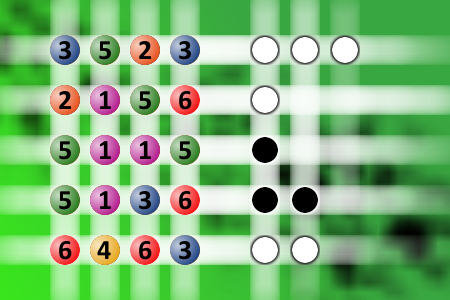
Find the right combination
[6817] Find the right combination - The computer chose a secret code (sequence of 4 digits from 1 to 6). Your goal is to find that code. Black circles indicate the number of hits on the right spot. White circles indicate the number of hits on the wrong spot. - #brainteasers #mastermind - Correct Answers: 27 - The first user who solved this task is Nasrin 24 T
BRAIN TEASERS
enter your answer and press button OK

Find the right combination

The computer chose a secret code (sequence of 4 digits from 1 to 6). Your goal is to find that code. Black circles indicate the number of hits on the right spot. White circles indicate the number of hits on the wrong spot.
Correct answers: 27
The first user who solved this task is Nasrin 24 T.
#brainteasers #mastermind
Register with your Google Account and start collecting points.
Check your ranking on list.

A man is sitting at the bar in...

A man is sitting at the bar in his local tavern, furiously gulping shots of whiskey. One of his friends happens to come into the bar and sees him.
"Lou," says the shocked friend, "what are you doing? I've known you for over fifteen years, and I've never seen you take a drink before. What's going on?"
Without even taking his eyes off his newly filled glass, the man replies, "My wife just ran off with my best friend."
He then throws back another shot of whisky in one gulp.
"But," says the other man, "I'm your best friend!"
The man turns to his friend, looks at him through bloodshot eyes, smiles, and then slurs, "Not anymore! ... He is!"
Jokes of the day - Daily updated jokes. New jokes every day.
Follow Brain Teasers on social networks

Brain Teasers

puzzles, riddles, mathematical problems, mastermind, cinemania...

Carl Friedrich Wilhelm Ludwig

Born 29 Dec 1816; died 23 Apr 1895 at age 78. German physiologist and biochemist who was one of the creators of modern physiology. He applied the experimental approach of chemistry and physics to explain the way the body functions. Ludwig investigated the structure of the kidneys and cardiac activity. The kymograph he invented (1847) continuously recorded blood pressure on a rotating drum. He explained blood circulation in terms of conventional forces, repudiating any mysterious "vital force." With his mercurial blood-gas pump (1859) he extracted gases from blood for study. In 1856, he was the first to keep an organ alive after removal from an animal (a frog heart), using perfusion (pumping blood plasma through them.) He was also first to study the nitrogen content of urine as a measure of protein metabolism.«
This site uses cookies to store information on your computer. Some are essential to help the site properly. Others give us insight into how the site is used and help us to optimize the user experience. See our privacy policy.