Find the right combination
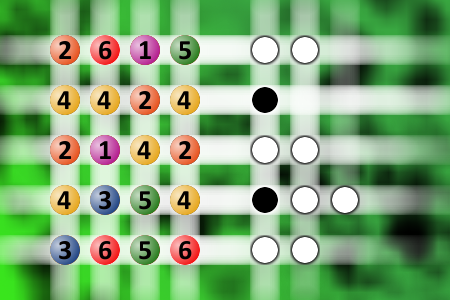
[7229] Find the right combination - The computer chose a secret code (sequence of 4 digits from 1 to 6). Your goal is to find that code. Black circles indicate the number of hits on the right spot. White circles indicate the number of hits on the wrong spot. - #brainteasers #mastermind - Correct Answers: 6
BRAIN TEASERS
enter your answer and press button OK

Find the right combination

The computer chose a secret code (sequence of 4 digits from 1 to 6). Your goal is to find that code. Black circles indicate the number of hits on the right spot. White circles indicate the number of hits on the wrong spot.
Correct answers: 6
#brainteasers #mastermind
Register with your Google Account and start collecting points.
Check your ranking on list.

A Department Store

A really huge muscular guy with a bad stutter goes to a counter in a department store and asks, "W-w-w-where`s the m-m-m-men`s dep-p-p-partment?"
The clerk behind the counter just looks at him and says nothing.
The man repeats himself: "W-w-w-where`s the m-m-m-men`s dep-p-p-partment?" Again, the clerk doesn`t answer him.
The guy asks several more times: "W-w-w-where`s the m-m-m-men`s dep-p-p-partment?"
And the clerk just seems to ignore him. Finally, the guy is angry and storms off.
The customer who was waiting in line behind the guy asks the clerk, "why wouldn`t you answer that guy's question?"
The clerk answers, "D-d-d-do you th-th-th-think I w-w-w-want to get b-b-b-beat up?!!"
Jokes of the day - Daily updated jokes. New jokes every day.
Follow Brain Teasers on social networks

Brain Teasers

puzzles, riddles, mathematical problems, mastermind, cinemania...

Peter Andreas Hansen

Died 28 Mar 1874 at age 78 (born 8 Dec 1795).Danish astronomer whose most important work was the improvement of the theories and tables of the orbits of the principal bodies in the solar system. At Altona observatory he assisted in measuring the arc of meridian (1821). He became the director (1825) of Seeberg observatory, which was removed to Gotha in a new observatory built for him (1857). He worked on theoretical geodesy, optics, and the theory of probability. The work in celestial mechanics for which he is best known are his theories of motion for comets, minor planets, moon and his lunar tables (1857) which were in use until 1923. He published his lunar theory in Fundamenta ("Foundation") in 1838, and Darlegung ("Explanation") in 1862-64.
This site uses cookies to store information on your computer. Some are essential to help the site properly. Others give us insight into how the site is used and help us to optimize the user experience. See our privacy policy.