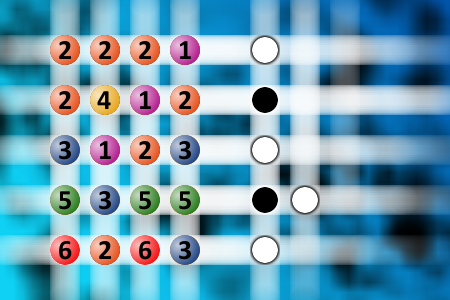
Find the right combination
[7390] Find the right combination - The computer chose a secret code (sequence of 4 digits from 1 to 6). Your goal is to find that code. Black circles indicate the number of hits on the right spot. White circles indicate the number of hits on the wrong spot. - #brainteasers #mastermind - Correct Answers: 6
BRAIN TEASERS
enter your answer and press button OK

Find the right combination

The computer chose a secret code (sequence of 4 digits from 1 to 6). Your goal is to find that code. Black circles indicate the number of hits on the right spot. White circles indicate the number of hits on the wrong spot.
Correct answers: 6
#brainteasers #mastermind
Register with your Google Account and start collecting points.
Check your ranking on list.

Wife's love

Bill pulled up a stool at his favorite bar and announced: "My wife Suzie must love me more than any woman has ever loved any man!"

"What makes you say that?" the bartender inquired.

"Last week," Bill explained, "I had to take a couple of sick days from work. Suzie was so thrilled to have me around that every time the milkman and the post office guy came by, she'd run down the driveway, waving her arms and hollering, 'My husband's home! My husband's home!'"

Jokes of the day - Daily updated jokes. New jokes every day.
Follow Brain Teasers on social networks

Brain Teasers

puzzles, riddles, mathematical problems, mastermind, cinemania...

Joseph Merrick

Born 5 Aug 1862; died 11 Apr 1890 at age 27.Joseph Carey Merrick (the Elephant Man) was an English patient (erroneously referred to as John Merrick) was a disfigured person. Born in Leicester, England, in 1862, Merrick began to develop tumours on his face before his second birthday. His condition quickly worsened as bulbous, cauliflower-like growths grew from his head and body, and his right hand and forearm became a useless club. After a brief career as a professional “freak,” dubbed the “Elephant Man” because of a tusklike growth on his face, he became the best-known resident patient of London Hospital from 1886 until his death. The modern diagnosis (1979) is the very rare disorder, Proteus Syndrome.
This site uses cookies to store information on your computer. Some are essential to help the site properly. Others give us insight into how the site is used and help us to optimize the user experience. See our privacy policy.