Find the right combination
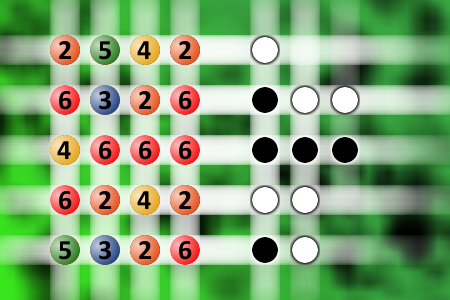
[7529] Find the right combination - The computer chose a secret code (sequence of 4 digits from 1 to 6). Your goal is to find that code. Black circles indicate the number of hits on the right spot. White circles indicate the number of hits on the wrong spot. - #brainteasers #mastermind - Correct Answers: 4
BRAIN TEASERS
enter your answer and press button OK

Find the right combination

The computer chose a secret code (sequence of 4 digits from 1 to 6). Your goal is to find that code. Black circles indicate the number of hits on the right spot. White circles indicate the number of hits on the wrong spot.
Correct answers: 4
#brainteasers #mastermind
Register with your Google Account and start collecting points.
Check your ranking on list.

One day the first grade teache...

One day the first grade teacher was reading the story of the Three Little Pigs to her class. She came to the part of the story where the first pig was trying to accumulate the building materials for his home. She read,"...and so the pig went up to the man with the wheel barrow full of straw and said, "Pardon me sir, but may I have some of that straw to build my house?"
The teacher paused then asked the class, "And what do you think that man said?"
One little boy raised his hand and said, "I think he said'Holy Sh*t! A talking pig!'"
The teacher was unable to teach for the next 10 minutes.
Jokes of the day - Daily updated jokes. New jokes every day.
Follow Brain Teasers on social networks

Brain Teasers

puzzles, riddles, mathematical problems, mastermind, cinemania...

First AIDS patient

In 1959, a 25-year-old patient, David Carr, an apprentice printer, entered the Royal Manchester Infirmary in England, with unusual symptoms, including purplish skin lesions, fatigue and weight loss. He died 4½ months later for reasons not then understood. His preserved tissue samples were examined in 1990. In a letter to the journal The Lancet, (7 Jul 1990) Gerald Corbitt, director of clinical virology at the hospital, suggested this could be the earliest known AIDS case. In 1995, the journal Nature, reported that the results were anomolous: the putative HIV detected was of a “relatively modern strain.” In the 20 Jan 1996 Lancet, the earlier claim was retracted, accepting the sample had been contaminated. Having had doubts since 1992, Corbitt said he regarded the analysis as no more than a trial of PCR [polymerase chain reaction] on archival material. Belatedly, the report of a possible early AIDS case was clarified.[Image: AIDS virus attacking a blood cell.]
This site uses cookies to store information on your computer. Some are essential to help the site properly. Others give us insight into how the site is used and help us to optimize the user experience. See our privacy policy.