Find the right combination
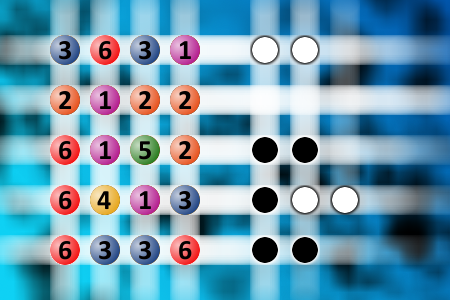
[7845] Find the right combination - The computer chose a secret code (sequence of 4 digits from 1 to 6). Your goal is to find that code. Black circles indicate the number of hits on the right spot. White circles indicate the number of hits on the wrong spot. - #brainteasers #mastermind - Correct Answers: 5
BRAIN TEASERS
enter your answer and press button OK

Find the right combination

The computer chose a secret code (sequence of 4 digits from 1 to 6). Your goal is to find that code. Black circles indicate the number of hits on the right spot. White circles indicate the number of hits on the wrong spot.
Correct answers: 5
#brainteasers #mastermind
Register with your Google Account and start collecting points.
Check your ranking on list.

Name the animals...

The first-grade teacher was showing pictures of animals to her students to see how many they could name. She held up a picture of a lamb, and a little girl said, "That's a sheep!"

"That's right!" said the teacher. "How about THIS one?" she said, holding up a picture of the king of beasts.

"That's a lion!" answered a little boy.

"Right!" said the teacher. Then she held up a picture of a deer. No one volunteered an answer. She tried to help. "What does your mother call your father?"

Johnny said, "I know! That's a lazy old goat!"

Jokes of the day - Daily updated jokes. New jokes every day.
Follow Brain Teasers on social networks

Brain Teasers

puzzles, riddles, mathematical problems, mastermind, cinemania...

Abdus Salam

Born 29 Jan 1926; died 21 Nov 1996 at age 70. Pakistani-British nuclear physicist who shared the 1979 Nobel Prize for Physics with Steven Weinberg and Sheldon Lee Glashow. Each had independently formulated a theory explaining the underlying unity of the weak nuclear force and the electromagnetic force. His hypothetical equations, which demonstrated an underlying relationship between the electromagnetic force and the weak nuclear force, postulated that the weak force must be transmitted by hitherto-undiscovered particles known as weak vector bosons, or W and Z bosons. Weinberg and Glashow reached a similar conclusion using a different line of reasoning. The existence of the W and Z bosons was eventually verified in 1983 by researchers using particle accelerators at CERN.
This site uses cookies to store information on your computer. Some are essential to help the site properly. Others give us insight into how the site is used and help us to optimize the user experience. See our privacy policy.