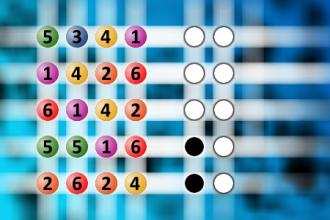
Find the right combination
[7890] Find the right combination - The computer chose a secret code (sequence of 4 digits from 1 to 6). Your goal is to find that code. Black circles indicate the number of hits on the right spot. White circles indicate the number of hits on the wrong spot. - #brainteasers #mastermind - Correct Answers: 2
BRAIN TEASERS
enter your answer and press button OK

Find the right combination

The computer chose a secret code (sequence of 4 digits from 1 to 6). Your goal is to find that code. Black circles indicate the number of hits on the right spot. White circles indicate the number of hits on the wrong spot.
Correct answers: 2
#brainteasers #mastermind

Register with your Google Account and start collecting points.
Check your ranking on list.

Kids in the back seat cause ac...

Kids in the back seat cause accidents; accidents in the back seat cause kids.
Never take life seriously. Nobody gets out alive, anyway.
An unbreakable toy is useful for breaking other toys.
Good health is merely the slowest possible rate at which one can die.
If FED EX and UPS were to merge, would they call it EF'D UP?
Everyone has a photographic memory; it's just that some of us are out of film.
How much deeper would the oceans be without sponges?
If quitters never win and winners never quit, what fool came up with, "Quit while your ahead"?!
If a deaf kid swears, does his mother wash his hands with soap?
If a turtle doesn't have a shell, is he homeless or naked?
What would a chair look like, if your knees bent the other way?
What do you do when you see an endangered animal eating an endangered plant?
Jokes of the day - Daily updated jokes. New jokes every day.
Follow Brain Teasers on social networks

Brain Teasers

puzzles, riddles, mathematical problems, mastermind, cinemania...

Henry A. Gleason

Born 2 Jan 1882; died 12 Apr 1975 at age 93. Henry Allan Gleason was an American botanist who was was active with the New York Botanical Garden for 32 years (1918-1950). By age 13, he already was a botany enthusiast. While still in high school, he contributed to The American Naturalist. Early in his career, he travelled to the Philippines, Java and Ceylon to studying tropical vegetation. In 1918, he gave a lecture on his findings, which led to the offer of a permanent position at NYBG, where he developed its South American collection.He was one of the first to consider community ecology. His paper on “The Individualistic Concept of the Plant Association” (1926) concluded that species tended to distribute themselves independently of one another. Eventually, his idea was embraced for the study of vegetation on an ecological and geographical basis. After retirement, he became emeritus head curator.«
This site uses cookies to store information on your computer. Some are essential to help the site properly. Others give us insight into how the site is used and help us to optimize the user experience. See our privacy policy.