Find the right combination
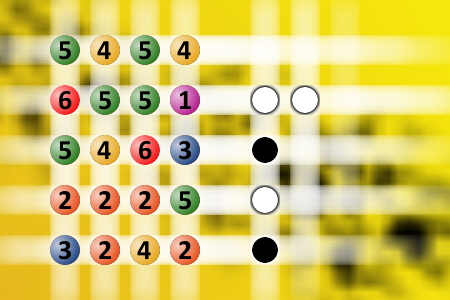
[8259] Find the right combination - The computer chose a secret code (sequence of 4 digits from 1 to 6). Your goal is to find that code. Black circles indicate the number of hits on the right spot. White circles indicate the number of hits on the wrong spot. - #brainteasers #mastermind - Correct Answers: 0
BRAIN TEASERS
enter your answer and press button OK

Find the right combination

The computer chose a secret code (sequence of 4 digits from 1 to 6). Your goal is to find that code. Black circles indicate the number of hits on the right spot. White circles indicate the number of hits on the wrong spot.
Correct answers: 0
#brainteasers #mastermind
Register with your Google Account and start collecting points.
Check your ranking on list.

All I want is a beer

One Friday night, a 17-year-old boy went into a bar and sat down at a table in the corner of the pool room. When the waitress walked over to his table, the teenager said: "Gimme a beer."

The waitress eyed him for a moment and said: "Look, sonny. Do you want to get me in trouble?"

The boy glanced back at her and replied: "Maybe later. Right now all I want is a beer."  

Jokes of the day - Daily updated jokes. New jokes every day.
Follow Brain Teasers on social networks

Brain Teasers

puzzles, riddles, mathematical problems, mastermind, cinemania...

Edward Joseph Hoffman

Died 1 Jul 2004 at age 62 (born 1 Jan 1942).American biomedical physicist whohelped create(1974) the PET Scanner (Positron Emission Tomography), which is used to detect cancers and other diseases.Michael E Phelps and others sharecreditfor this invention. A patient is prepared for a PET scan with an injection of slightly radioactive material, typically tagging molecules that behave like glucose within the body. Since cancerous tissues consume glucose, the scanner can then detect their location. PET technology can also be employed in the diagnosis of cardiovascular disease and Alzheimer's disease. Hoffman further developed the PET Scanner for use in making quantitative measurements. He became internationally known in the field of medical imaging. By the time he died in 2004, some 1,500 scanners were in use as a powerful diagnostic tool for saving or extending lives.«
This site uses cookies to store information on your computer. Some are essential to help the site properly. Others give us insight into how the site is used and help us to optimize the user experience. See our privacy policy.