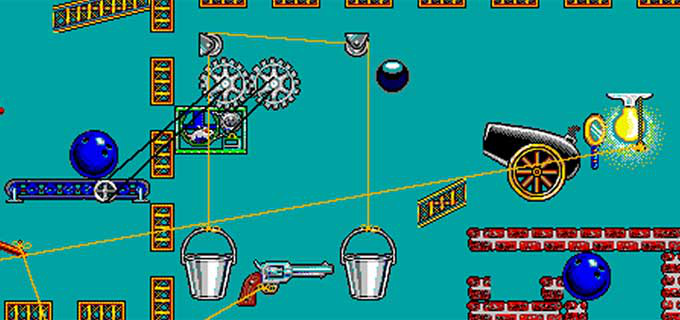
Guess the Game Name
[1849] Guess the Game Name - Look carefully the picture and guess the game name. - #brainteasers #games - Correct Answers: 35 - The first user who solved this task is Sanja Šabović
BRAIN TEASERS
enter your answer and press button OK

Guess the Game Name

Look carefully the picture and guess the game name.
Correct answers: 35
The first user who solved this task is Sanja Šabović.
#brainteasers #games
Register with your Google Account and start collecting points.
Check your ranking on list.

This Guy’s Got His Panhandling Strategy Sorted

Jose and Carlos are panhandlers that panhandle in different areas of town.
Carlos panhandles just as long as Jose but only collects $2-3 every day.
Jose brings home a suitcase FULL of $10 bills every day, drives a Mercedes, lives in a mortgage-free house and has a lot of money to spend.
One day, Carlos asked Jose: “I work just as long and hard as you do, but how do you bring home a suitcase full of $10 bills every day?”
“Look at your sign, what does it say?” replies Jose.
Carlos’ sign reads: “I have no work, a wife and six kids to support.”
Jose says: “no wonder you only get $2-3.”
‘Carlos says: “So what does your sign say then?”
Jose shows Carlos his sign – it reads: “I only need another $10 to move back to Mexico”

Jokes of the day - Daily updated jokes. New jokes every day.
Follow Brain Teasers on social networks

Brain Teasers

puzzles, riddles, mathematical problems, mastermind, cinemania...

Sir John Herschel

Born 7 Mar 1792; died 11 May 1871 at age 79. Sir John Frederick William Herschel was an English astronomer, chemist and chemist (1st Baronet), who, as asuccessor to his father Sir William Herschel, discovered a further 525 nebulae and clusters. John Herschel was a pioneer in celestial photography, and as a chemist contributed to the development of sensitized photographic paper (independently of Henry Talbot). In 1819, he discovered that sodium thiosulphate dissolved silver salts, as used in developing photographs. He introduced the terms positive image and negative image. Being diverse in his research, he also studied physical and geometrical optics, birefringence of crystals, spectrum analysis, and the interference of light and sound waves. To compare the brightness of stars, he invented the astrometer.
This site uses cookies to store information on your computer. Some are essential to help the site properly. Others give us insight into how the site is used and help us to optimize the user experience. See our privacy policy.