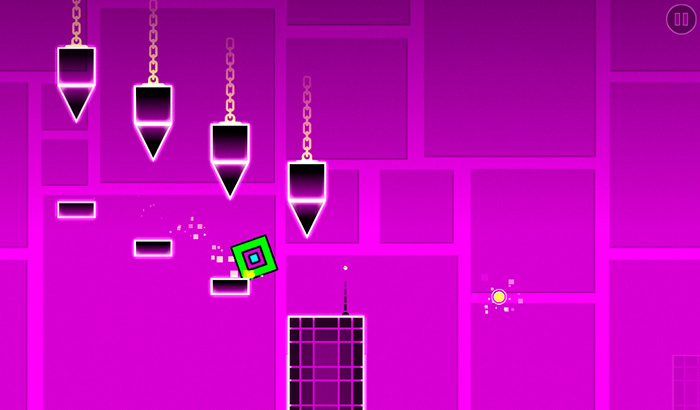
Guess the Game Name
[3403] Guess the Game Name - Look carefully the picture and guess the game name. - #brainteasers #games - Correct Answers: 33 - The first user who solved this task is Vladimir Krnac
BRAIN TEASERS
enter your answer and press button OK

Guess the Game Name

Look carefully the picture and guess the game name.
Correct answers: 33
The first user who solved this task is Vladimir Krnac.
#brainteasers #games
Register with your Google Account and start collecting points.
Check your ranking on list.

What does that one do?

A man entered a pet shop, wanting to buy a parrot. The shop owner pointed out three identical parrots on a perch and said, "The parrot to the left costs 500 dollars."

"Why does that parrot cost so much?" the man wondered.

The owner replied, "Well, it knows how to use a computer."

The man asked about the next parrot on the perch.

"That one costs 1,000 dollars because it can do everything the other parrot can do, plus it knows how to use the UNIX operating system." Naturally, the startled customer asked about the third parrot.

"That one costs 2,000 dollars."

"And what does that one do?" the man asked.

The owner replied, "To be honest, I've never seen him do a thing, but the other two call him boss!"

Jokes of the day - Daily updated jokes. New jokes every day.
Follow Brain Teasers on social networks

Brain Teasers

puzzles, riddles, mathematical problems, mastermind, cinemania...

Sir Godfrey Newbold Hounsfield

Born 28 Aug 1919; died 12 Aug 2004 at age 84.English electrical engineer who shared the 1979 Nobel Prize for Physiology or Medicine (with Allan Cormack) for creation of computerised axial tomography (CAT) scanners. He originated the idea during a country walk in 1967 when he realized that the contents of a box could be reconstructed by taking readings at all angles through it. He applied the concept for scanning the brain using hundreds of X-ray beams imaging cross-sections that were reconstructed as high-resolution graphics by a computer program handling complex algebraic calculations. By 1973 his CAT scanner could produce cross-section images of a brain in 4-1/2-min, invaluable for the diagnosis of brain diseases. He later built larger machines able to make a full body scan.«
This site uses cookies to store information on your computer. Some are essential to help the site properly. Others give us insight into how the site is used and help us to optimize the user experience. See our privacy policy.