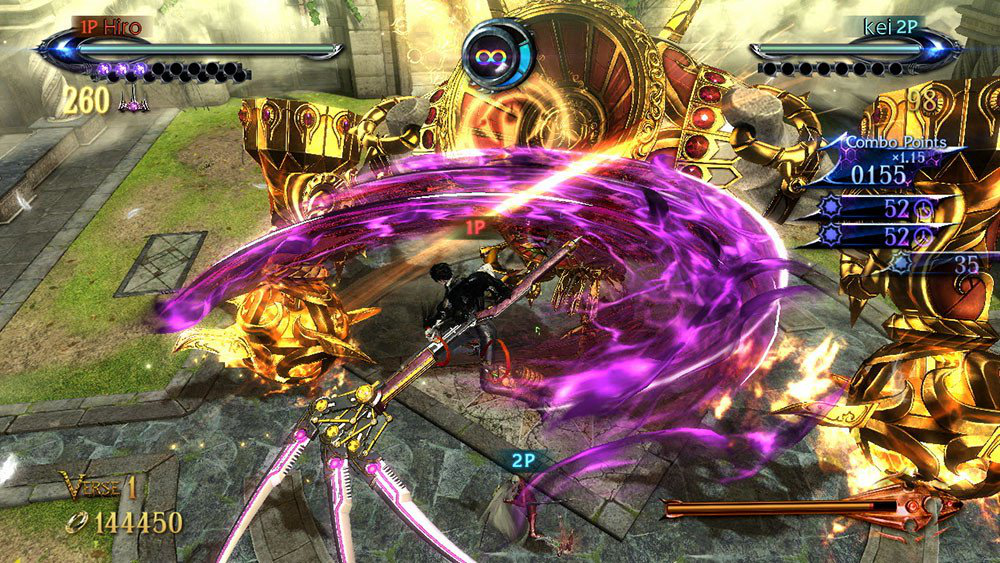
Guess the Game Name
[5348] Guess the Game Name - Look carefully the picture and guess the game name. - #brainteasers #games - Correct Answers: 19 - The first user who solved this task is Alfa Omega
BRAIN TEASERS
enter your answer and press button OK

Guess the Game Name

Look carefully the picture and guess the game name.
Correct answers: 19
The first user who solved this task is Alfa Omega.
#brainteasers #games
Register with your Google Account and start collecting points.
Check your ranking on list.

I recently had a visitor from...

I recently had a visitor from the state of Texas. For three days all I heard from him was "In Texas we have the best this, the largest that, the fastest that," etc. It eventually became very annoying.
Being from Niagra Falls, I thought I could outdo him by showing him the "Mighty Niagara", knowing there was nothing in Texas that could compare to this "Wonder of Water and Power".
While standing at the brink watching millions of gallons of water rushing over, I noticed the look of awe in his eyes. It was then I asked him: "Do you have anything like this in Texas?"
He waited a moment before he answered: "No, but we have a plumber that could fix it."
Jokes of the day - Daily updated jokes. New jokes every day.
Follow Brain Teasers on social networks

Brain Teasers

puzzles, riddles, mathematical problems, mastermind, cinemania...

Sir Ernest Rutherford

Born 30 Aug 1871; died 19 Oct 1937 at age 66. (1st Baron Rutherford of Nelson) Sir Ernest Rutherford was a New Zealand-English physicist who laid the groundwork for the development of nuclear physics. He worked under Sir J. J. Thomson at Cambridge University (1895-98). Then he collaborated with Frederick Soddy in studying radioactivity. On 1 Sep 1898 he dateda paper naming alpha particles and beta particles (Gamma radiation was discovered in 1900 by Paul Villard.) the following year. In 1905, with Soddy, he announced that radioactive decay involves a series of transformations. In 1907, with Hans Geiger and Ernest Marsden, he devised the alpha-particle scattering experiment that led in 1911 to the discovery of the atomic nucleus. In 1919 he achieved the artificial splitting of light atoms. In 1908 he was awarded the Nobel Prize for Chemistry.
This site uses cookies to store information on your computer. Some are essential to help the site properly. Others give us insight into how the site is used and help us to optimize the user experience. See our privacy policy.