
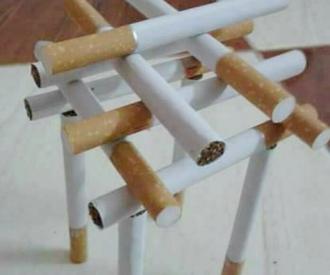
How many cigarettes do you see in this picture?
[3209] How many cigarettes do you see in this picture? - How many cigarettes do you see in this picture? - #brainteasers #riddles - Correct Answers: 318 - The first user who solved this task is Sanja Šabović
BRAIN TEASERS
enter your answer and press button OK

How many cigarettes do you see in this picture?

How many cigarettes do you see in this picture?
Correct answers: 318
The first user who solved this task is Sanja Šabović.
#brainteasers #riddles
Register with your Google Account and start collecting points.
Check your ranking on list.

What day is it?

Over breakfast one morning, a woman said to her husband, "I bet you don't know what day this is."

"Of course I do," he indignantly answered, getting up from the table and going out the door to the office.

At 10am, the doorbell rang. When the woman opened the door, she was handed a box containing a dozen long-stemmed red roses. At 1pm, a foil-wrapped, two-pound box of her favorite chocolates arrived. Later, a boutique delivered a designer dress.

The woman couldn't wait for her husband to come home. When he did, she exclaimed, "First the flowers, then the chocolates and then the dress! I've never had a more wonderful Groundhog Day in my life!"

Jokes of the day - Daily updated jokes. New jokes every day.
Follow Brain Teasers on social networks

Brain Teasers

puzzles, riddles, mathematical problems, mastermind, cinemania...

Eric F. Wieschaus

Born 8 Jun 1947.American developmental biologist who shared the 1995 Nobel Prize for Physiology or Medicine, with geneticists Edward B. Lewis and Christiane Nüsslein-Volhard, for discovering the genetic controls of early embryonic development. Wieschaus worked together with Nüsslein-Volhard examining mutations in 40,000 fruit fly families. They discovered (1980) that about 5,000 of the fly's 20,000 genes are important to embryonic development and about 140 are essential. They formed the widely accepted model that three sets of genes control subdivision in the developing embryo: gap genes, pair-rule genes and segment-polarity genes. Their work helped scientists to better understand congenital mutations in other animals, including humans.
This site uses cookies to store information on your computer. Some are essential to help the site properly. Others give us insight into how the site is used and help us to optimize the user experience. See our privacy policy.