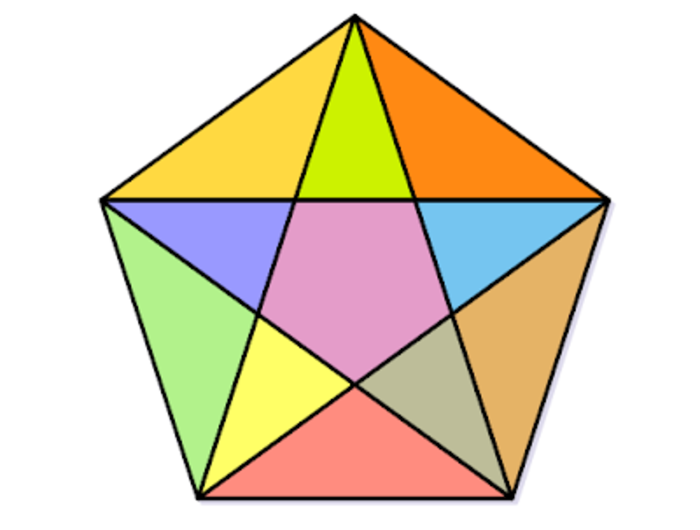
How many triangles are there...
[6308] How many triangles are there... - How many triangles are there in the picture? - #brainteasers #math #riddles - Correct Answers: 97 - The first user who solved this task is Nasrin 24 T
BRAIN TEASERS
enter your answer and press button OK

How many triangles are there...

How many triangles are there in the picture?
Correct answers: 97
The first user who solved this task is Nasrin 24 T.
#brainteasers #math #riddles
Register with your Google Account and start collecting points.
Check your ranking on list.

You know what i love most about us

You know what i love most about us ? I love how comfortable we are with each other. I love how we endlessly make fun of each other,
but never take the teasing to heart. I absolutely adore how when i turn away from you when we're fighting, you try to stay mad, then run after me.
I love the look in your eyes when we kiss, or how you stay up to watch me sleep. I love how i can call you anytime when i need someone and somehow you never cease to make me laugh. I love how you need me as much as I need you. And most of all, I love how you love me.
Jokes of the day - Daily updated jokes. New jokes every day.
Follow Brain Teasers on social networks

Brain Teasers

puzzles, riddles, mathematical problems, mastermind, cinemania...

Hermann Joseph Muller

Born 21 Dec 1890; died 5 Apr 1967 at age 76. American geneticist who demonstrated that mutations and hereditary changes could be caused by X-rays striking the genes and chromosomes of living cells (first produced in the fruit fly Drosophila in 1927). His first task - to create procedures to exactly measure the mutation frequency - took several years. Then he investigated the effect of different agents on the frequency of mutations. He found that experiments could be arranged, for instance, so that nearly 100 per cent of the offspring of irradiated flies showed mutations. Thus a possibility had been created for the first time of influencing the hereditary mass itself artificially. Muller was awarded the Nobel Prize for Physiology or Medicine in 1946.«
This site uses cookies to store information on your computer. Some are essential to help the site properly. Others give us insight into how the site is used and help us to optimize the user experience. See our privacy policy.