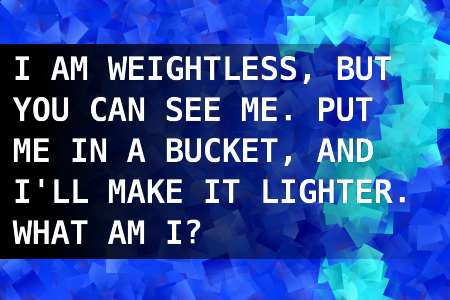
I am weightless, but you can s...
[3129] I am weightless, but you can s... - I am weightless, but you can see me. Put me in a bucket, and I'll make it lighter. What am I? - #brainteasers #riddles - Correct Answers: 70 - The first user who solved this task is Jasmina Atarac
BRAIN TEASERS
enter your answer and press button OK

I am weightless, but you can s...

I am weightless, but you can see me. Put me in a bucket, and I'll make it lighter. What am I?
Correct answers: 70
The first user who solved this task is Jasmina Atarac.
#brainteasers #riddles
Register with your Google Account and start collecting points.
Check your ranking on list.

A very shy guy goes into a bar...

A very shy guy goes into a bar and sees a beautiful woman sitting at thebar. After an hour of gathering up his courage he finally goes over to herand asks, tentatively, "Um, would you mind if I chatted with you for awhile?"
She responds by yelling, at the top of her lungs, "No, I won't sleep withyou tonight!" Everyone in the bar is now staring at them.
Naturally, the guy is hopelessly and completely embarrassed and he slinksback to his table.
After a few minutes, the woman walks over to him and apologizes. Shesmiles at him and says, "I'm sorry if I embarrassed you. You see, I'm agraduate student in psychology and I'm studying how people respond toembarrassing situations."
To which he responds, at the top of his lungs, "What do you mean $200?"
Jokes of the day - Daily updated jokes. New jokes every day.
Follow Brain Teasers on social networks

Brain Teasers

puzzles, riddles, mathematical problems, mastermind, cinemania...

Heber Curtis

Born 27 Jun 1872; died 9 Jan 1942 at age 69. Heber Doust Curtis was an American astronomer who is famed for debating Harlow Shapley on 26 Apr 1920 before the National academy of Sciences. He spoke for “island universes”—whereby spiral nebulae were composed of stars, and represented galaxies far outside the Milky Way. Shapley disagreed, believing that our galaxy was 300,000 light-years in diameter and included the spiral nebulae. By the end of 1924, Curtis was shown to be correct, when a paper from Edwin Hubble was read to the American Astronomical Society on 1 Jan 1925. Curtis had joined Lick Observatory after completing his Ph.D. in 1902. After his early work measuring radial velocities of the brighter stars, but in 1910 he became active in nebular photography, trying to find evidence of their nature as isolated independent star systems.«
This site uses cookies to store information on your computer. Some are essential to help the site properly. Others give us insight into how the site is used and help us to optimize the user experience. See our privacy policy.