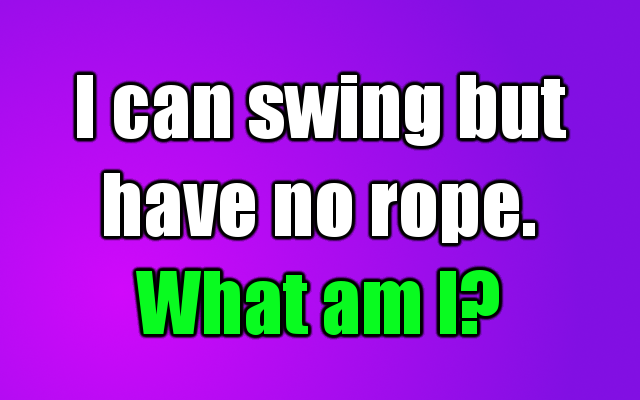
I can swing but have no rope...
[3601] I can swing but have no rope... - I can swing but have no rope. What am I? - #brainteasers #riddles - Correct Answers: 44 - The first user who solved this task is Sanja Šabović
BRAIN TEASERS
enter your answer and press button OK

I can swing but have no rope...

I can swing but have no rope. What am I?
Correct answers: 44
The first user who solved this task is Sanja Šabović.
#brainteasers #riddles
Register with your Google Account and start collecting points.
Check your ranking on list.

Husband and wife are waiting a...

Husband and wife are waiting at the bus stop with their nine children. A blind man joins them after a few minutes. When the bus arrives, they find it overloaded and only the wife and the nine kids are able to fit onto the bus.
So the husband and the blind man decide to walk. After a while, the husband gets irritated by the ticking of the stick of the blind man as he taps it on the sidewalk, and says to him, "Why don't you put a piece of rubber at the end of your stick? That ticking sound is driving me crazy."
The blind man replies, "If you would've put a rubber at the end of YOUR stick, we'd be riding the bus ... so shut up."
Jokes of the day - Daily updated jokes. New jokes every day.
Follow Brain Teasers on social networks

Brain Teasers

puzzles, riddles, mathematical problems, mastermind, cinemania...

Potatoes

In 1586, potatoes were introduced to Britain by Sir Thomas Harriot, an English scientist and mathematician, according to one traditional—but doubtful—story. In fact, the origin of the potato is not definitively known, and there are other theories. It is known that Harriot was on a 1585 expedition to Virginia, where he stayed to survey and report on the resources there. That expedition returned to England, landing at Plymouth on 27 Jul 1586. Harriot may have brought back plant specimens, and the story suggests he gave a sample from Virginia to his patron, Sir Walter Raleigh, who grew it on his Irish estate. However, Harriot's report published in 1587 describes plants he observed, none named as a potato, nor that match the ordinary potato. Furthermore, the potato is not recognized as being indiginous in Virginia.«
This site uses cookies to store information on your computer. Some are essential to help the site properly. Others give us insight into how the site is used and help us to optimize the user experience. See our privacy policy.