I speak without a mouth and ...
[6317] I speak without a mouth and ... - I speak without a mouth and hear without ears. I have no body, but I come alive with wind. What am I? - #brainteasers #riddles - Correct Answers: 34 - The first user who solved this task is Nasrin 24 T
BRAIN TEASERS
enter your answer and press button OK

I speak without a mouth and ...

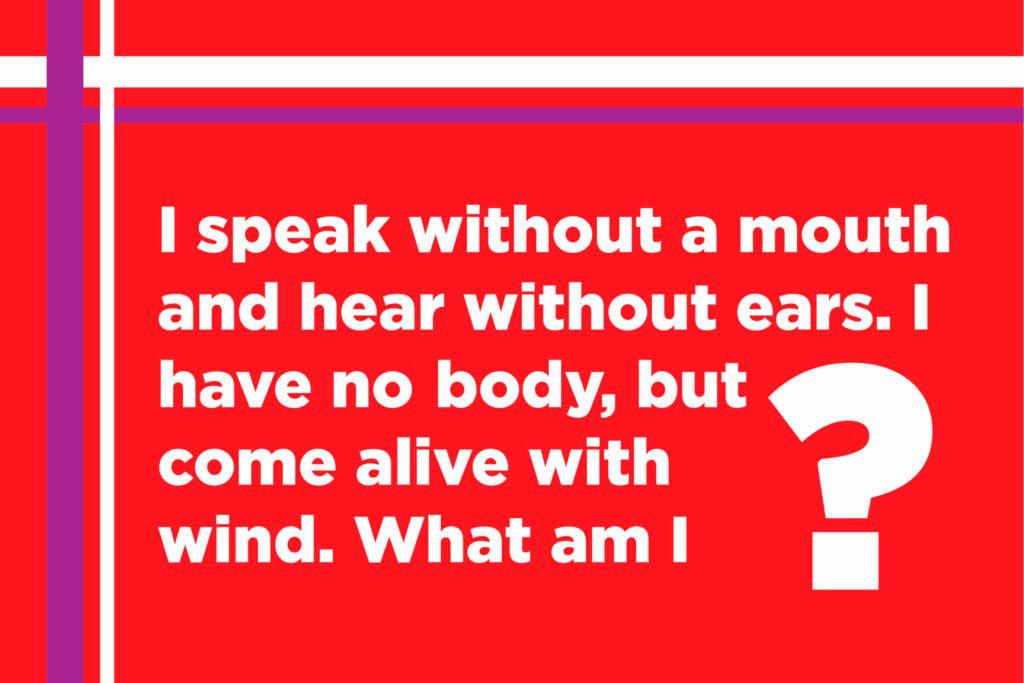
I speak without a mouth and hear without ears. I have no body, but I come alive with wind. What am I?
Correct answers: 34
The first user who solved this task is Nasrin 24 T.
#brainteasers #riddles
Register with your Google Account and start collecting points.
Check your ranking on list.

One day a brunette, a redhead...

One day a brunette, a redhead and a blonde decide to go through their daughter's purses.
So, the brunette goes through her daughter's purse and finds cigarettes. She says, "Oh my, I'm so ashamed! My Daughter smokes."
So, the redhead goes through her daughter's purse and finds an empty can of beer. She says, "Oh my, I'm so ashamed! My daughter drinks."
So, finally, it's the blondes turn and she finds a used condom. She says, "Oh my, I'm so ashamed! My daughter has a penis."
Jokes of the day - Daily updated jokes. New jokes every day.
Follow Brain Teasers on social networks

Brain Teasers

puzzles, riddles, mathematical problems, mastermind, cinemania...

C. Lloyd Morgan

Died 6 Mar 1936 at age 84 (born 6 Feb 1852).C(onwy) Lloyd Morgan was a British zoologist and psychologist, best remembered for coining Morgan's Canon expressing that the interpretation of animal behavior should be described in the simplest possible terms: "In no case may we interpret an action as the outcome of the exercise of a higher psychical faculty, if it can be interpreted as the outcome of one which stands lower in the psychological scale." (In 1947, Philip L. Harriman stated that Morgan's Canon was simply a specialised form of Occam's razor applied to animal psychology.) For his work, Morgan is sometimes called the founder of comparative, or animal, psychology. His Canon was significant in developing concepts of behaviorism in twentieth century academic psychology.«
This site uses cookies to store information on your computer. Some are essential to help the site properly. Others give us insight into how the site is used and help us to optimize the user experience. See our privacy policy.