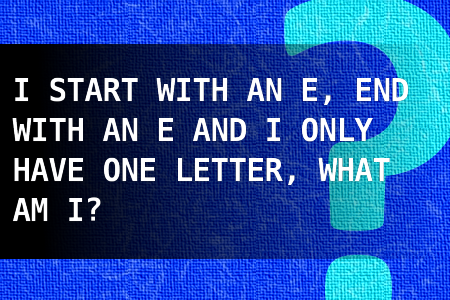
I start with an E, end with an...
[3424] I start with an E, end with an... - I start with an E, end with an E and I only have one letter, what am I? - #brainteasers #riddles - Correct Answers: 86 - The first user who solved this task is On On Lunarbasil
BRAIN TEASERS
enter your answer and press button OK

I start with an E, end with an...

I start with an E, end with an E and I only have one letter, what am I?
Correct answers: 86
The first user who solved this task is On On Lunarbasil.
#brainteasers #riddles
Register with your Google Account and start collecting points.
Check your ranking on list.

A passenger in a taxi leaned o...

A passenger in a taxi leaned over to ask the driver a question and tapped him on the shoulder. The driver screamed, lost control of the cab, nearly hit a bus, drove up over the curb, and stopped just inches from a large plate glass window.

For a few moments everything was silent in the cab, and then the still shaking driver said, "I'm sorry but you scared the daylights out of me."

The frightened passenger apologized to the driver and said he didn't realize a mere tap on the shoulder could frighten him so much.

The driver replied, "No, no, I'm sorry, it's entirely my fault. Today is my first day driving a cab. I've been driving a hearse for the last 25 years."

Jokes of the day - Daily updated jokes. New jokes every day.
Follow Brain Teasers on social networks

Brain Teasers

puzzles, riddles, mathematical problems, mastermind, cinemania...

Alan G. MacDiarmid

Born 14 Apr 1927; died 7 Feb 2007 at age 79.Alan Graham MacDiarmid was a New Zealand-American chemist whosharedthe 2000 Nobel Prize in Chemistry (with Alan Heeger and Hideki Shirakawa) “for the discovery and development of conductive polymers.”Plastics (formed of repeated units in long-chain polymer molecules) most often do not conduct electricity, and are used for insulation. At the end of the 1970's, these scientists devised polymer materials that were semi-conductors, able to conduct electricity. Practical applications now include conductive polymers in “smart”windows able to exclude sunlight, light-emitting diodes, solar cells and displays for mobile telephones and small television screens. Research has been stimulated to attempt to produce transistors consisting of individual molecules with which to dramatically reduce the size of computers.«
This site uses cookies to store information on your computer. Some are essential to help the site properly. Others give us insight into how the site is used and help us to optimize the user experience. See our privacy policy.