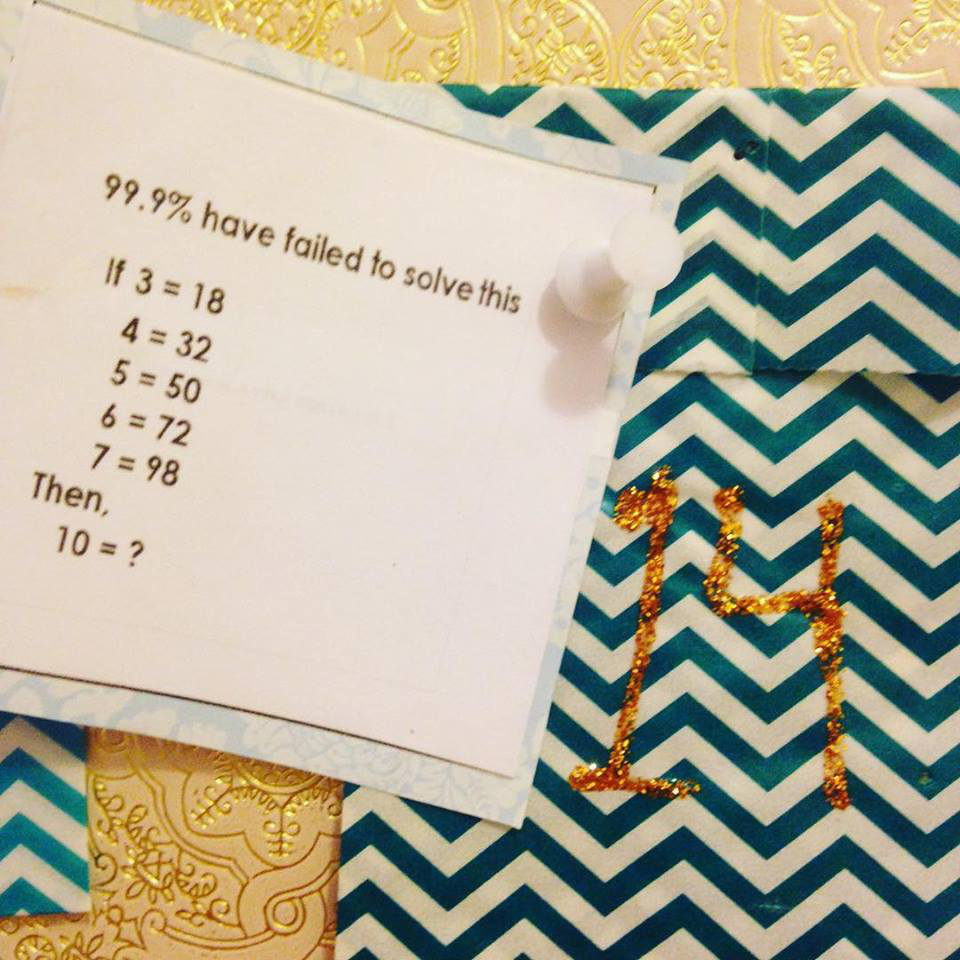
If 3=18, 4=32, 5=50, 6=72, 7...
[1725] If 3=18, 4=32, 5=50, 6=72, 7... - If 3=18, 4=32, 5=50, 6=72, 7=98 then 10=? - #brainteasers #math #riddles - Author: The Math Guru - Correct Answers: 141 - The first user who solved this task is Sanja Šabović
BRAIN TEASERS
enter your answer and press button OK

If 3=18, 4=32, 5=50, 6=72, 7...

If 3=18, 4=32, 5=50, 6=72, 7=98 then 10=?
Author: The Math Guru
Correct answers: 141
The first user who solved this task is Sanja Šabović.
#brainteasers #math #riddles
Register with your Google Account and start collecting points.
Check your ranking on list.

Cabbie

One dismal rainy night in Sydney a taxi driver spotted an arm waving from the shadows of an alley. Even before he rolled to a stop at the curb, a figure leaped into the cab and slammed the door.

Checking his rear view mirror as he pulled away, he was startled to see a dripping wet, naked woman sitting in the back seat.

'Where to?' he stammered.

'Kings Cross,' answered the woman.

'You got it,' he said, taking another long glance in the mirror.

The woman caught him staring at her and asked, 'Just what the hell are you looking at, driver?'

'Well, madam,' he answered, 'I was just wondering how you'll pay your fare.'

The woman spread her legs, put her feet up on the front seat, smiled at the driver and said,

'Does this answer your question?'

Still looking in the mirror, the cabbie asked, 'Got anything smaller?'

Jokes of the day - Daily updated jokes. New jokes every day.
Follow Brain Teasers on social networks

Brain Teasers

puzzles, riddles, mathematical problems, mastermind, cinemania...

Theodor Schwann

Born 7 Dec 1810; died 11 Jan 1882 at age 71. German physiologist who founded modern histology by defining the cell in Mikroskopische Untersuchungen (1839) as the basic unit of animal structure that makes elementary parts (such as teeth, bone, muscle, cartilage, nerve tissue) by cell differentiation. This laid the foundations for the cell theory. Schwann also worked on fermentation and discovered the enzyme pepsin. Schwann cells are named after him. He also investigated muscular contraction and nerve structure; discovered the striated muscle in the upper esophagus and the Schwann sheath; identified the role of microorganisms in putrefaction; formulated basic principles of embryology (that the egg is a single cell that develops into a complete organism); and coined the term metabolism.
This site uses cookies to store information on your computer. Some are essential to help the site properly. Others give us insight into how the site is used and help us to optimize the user experience. See our privacy policy.