In the following circles, th...
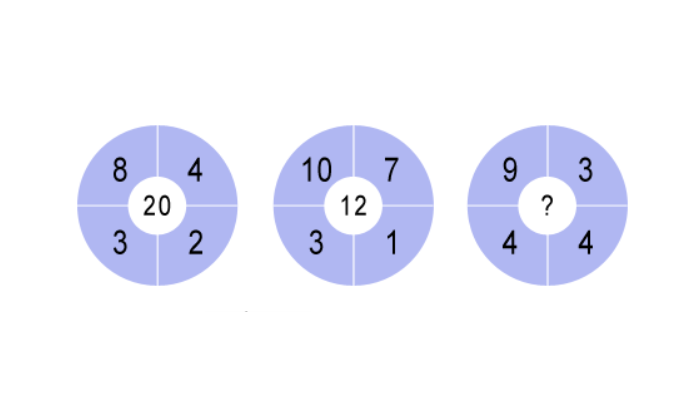
[2779] In the following circles, th... - In the following circles, the four outer numbers are used to calculate the number in the middle. Can you figure out the rule to determine what number should replace the question mark in the third circle? - #brainteasers #math #riddles - Correct Answers: 108 - The first user who solved this task is Jakubovski Vladimir
BRAIN TEASERS
enter your answer and press button OK

In the following circles, th...

In the following circles, the four outer numbers are used to calculate the number in the middle. Can you figure out the rule to determine what number should replace the question mark in the third circle?
Correct answers: 108
The first user who solved this task is Jakubovski Vladimir.
#brainteasers #math #riddles
Register with your Google Account and start collecting points.
Check your ranking on list.

A blonde and a redhead met in ...

A blonde and a redhead met in a bar after work for a drink, and were watching the 6 O'clock news. A man was shown threatening to jump from the Brooklyn Bridge.
The blonde bet the redhead $50 that he wouldn't jump, and the redhead replied, 'I'll take that bet!'
Anyway, sure enough, he jumped, so the blonde gave the redhead the $50 she owed. The redhead said 'I can't take this, you're my friend.'
The blonde said 'No. A bet's a bet'.
So the redhead said 'Listen, I have to admit, I saw this on the 5 O'clock news, so I can't take your money'.
The blonde replied, 'Well, so did I, but I never thought he'd jump again!'
Jokes of the day - Daily updated jokes. New jokes every day.
Follow Brain Teasers on social networks

Brain Teasers

puzzles, riddles, mathematical problems, mastermind, cinemania...

J. Willard Gibbs

Died 28 Apr 1903 at age 64 (born 11 Feb 1839). Josiah Willard Gibbs was an American mathematical physicist and chemist known for contributions to vector analysis and as one of the founders of physical chemistry. In 1863, He was awarded Yale University's first engineering doctorate degree. His major work was in developing thermodynamic theory, which brought physical chemistry from an empirical enquiry to a deductive science. In 1873, he published two papers concerning the fundamental nature of entropy of a system, and established the “thermodynamic surface,” a geometrical and graphical method for the analysis of the thermodynamic properties of substances. His famous On the Equilibrium of Homogeneous Substances, published in 1876, established the use of “chemical potential,” now an important concept in physical chemistry.«
This site uses cookies to store information on your computer. Some are essential to help the site properly. Others give us insight into how the site is used and help us to optimize the user experience. See our privacy policy.