MAGIC SQUARE: Calculate A-B*C
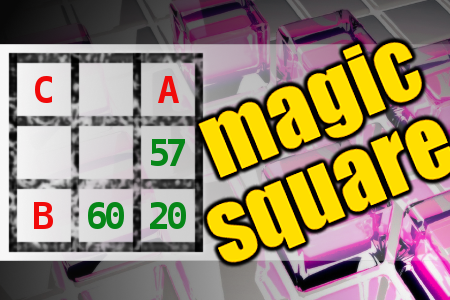
[2494] MAGIC SQUARE: Calculate A-B*C - The aim is to place the some numbers from the list (2, 5, 6, 16, 19, 20, 57, 60, 61, 99) into the empty squares and squares marked with A, B an C. Sum of each row and column should be equal. All the numbers of the magic square must be different. Find values for A, B, and C. Solution is A-B*C. - #brainteasers #math #magicsquare - Correct Answers: 43 - The first user who solved this task is Roxana zavari
BRAIN TEASERS
enter your answer and press button OK

MAGIC SQUARE: Calculate A-B*C

The aim is to place the some numbers from the list (2, 5, 6, 16, 19, 20, 57, 60, 61, 99) into the empty squares and squares marked with A, B an C. Sum of each row and column should be equal. All the numbers of the magic square must be different. Find values for A, B, and C. Solution is A-B*C.
Correct answers: 43
The first user who solved this task is Roxana zavari.
#brainteasers #math #magicsquare
Register with your Google Account and start collecting points.
Check your ranking on list.

Ponderings Collection 09


Why call then hot water heaters if the water is already hot?
If you throw a cat out a car window does it become kitty litter?
If corn oil comes from corn, where does baby oil come from?
If there is no God, who pops up the next Kleenex in the box?
When a cow laughs does milk come up its nose?
Why do they put braille on the number pads of drive-through bank machines?
How did a fool and his money GET together?
If nothing sticks to Teflon, how do they stick Teflon on the pan?
How do they get a deer to cross at that yellow road sign?
If it's tourist season, why can't we shoot them?
Jokes of the day - Daily updated jokes. New jokes every day.
Follow Brain Teasers on social networks

Brain Teasers

puzzles, riddles, mathematical problems, mastermind, cinemania...

Sir William Osler

Born 12 Jul 1849; died 29 Dec 1919 at age 70. (Baronet) Canadian physician who revolutionized the medical curriculum in North America, adapting the best of the systems he had observed in England and Germany. He believed that students learn best by doing, teaching medical students at the bedside. He introduced postgraduate training system, instituting a general internship of one year to be followed by a residency of several years. His textbook, The Principles and Practice of Medicine (1892) included the advances of the previous half-century in clinical medical science, and remained the standard text for 40 years. Early in his life, in 1873, he made the most careful description to date of what later were called the "blood-platelets," which was presented to the Royal Society.«
This site uses cookies to store information on your computer. Some are essential to help the site properly. Others give us insight into how the site is used and help us to optimize the user experience. See our privacy policy.