MAGIC SQUARE: Calculate A+B+C
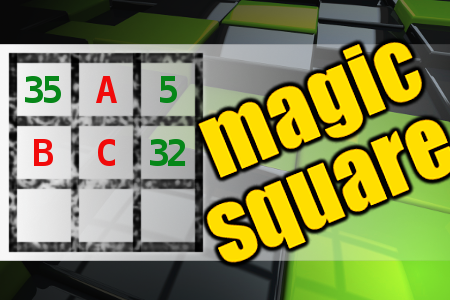
[4307] MAGIC SQUARE: Calculate A+B+C - The aim is to place the some numbers from the list (1, 4, 5, 7, 23, 24, 26, 32, 33, 35, 75, 86) into the empty squares and squares marked with A, B an C. Sum of each row and column should be equal. All the numbers of the magic square must be different. Find values for A, B, and C. Solution is A+B+C. - #brainteasers #math #magicsquare - Correct Answers: 22 - The first user who solved this task is Manguexa Wagle
BRAIN TEASERS
enter your answer and press button OK

MAGIC SQUARE: Calculate A+B+C

The aim is to place the some numbers from the list (1, 4, 5, 7, 23, 24, 26, 32, 33, 35, 75, 86) into the empty squares and squares marked with A, B an C. Sum of each row and column should be equal. All the numbers of the magic square must be different. Find values for A, B, and C. Solution is A+B+C.
Correct answers: 22
The first user who solved this task is Manguexa Wagle.
#brainteasers #math #magicsquare
Register with your Google Account and start collecting points.
Check your ranking on list.

An angry wife to her husband o...

An angry wife to her husband on phone: "Where the hell are you?"
Husband: "Darling, you remember that jewelery shop where you saw the diamond necklace and totally fell in love with it, and I didn't have money that time, and I said 'Baby it'll be yours one day'?"
Wife, with a smile and blushing: "Yeah I remember that my love!"
Husband: "I'm in the pub just next to that shop."
Jokes of the day - Daily updated jokes. New jokes every day.
Follow Brain Teasers on social networks

Brain Teasers

puzzles, riddles, mathematical problems, mastermind, cinemania...

Great White Way

In 1880, New York's Broadway was first lighted by electricity and became known as the “Great White Way.” Charles F. Brush successfully demonstrated his arc lamps along Broadway. His arc lights preceded Edison's incandescent light bulb in commercial use. Arc lights were suited to applications where a bright light was needed, such as street lights and lighting in commercial and public buildings.[Image: detail from the cover of the Scientific American issue of 2 Apr 1881.]
This site uses cookies to store information on your computer. Some are essential to help the site properly. Others give us insight into how the site is used and help us to optimize the user experience. See our privacy policy.