
MAGIC SQUARE: Calculate A+B*C
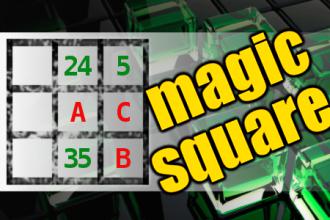
[4849] MAGIC SQUARE: Calculate A+B*C - The aim is to place the some numbers from the list (2, 3, 5, 24, 25, 27, 32, 33, 35, 37, 82) into the empty squares and squares marked with A, B an C. Sum of each row and column should be equal. All the numbers of the magic square must be different. Find values for A, B, and C. Solution is A+B*C. - #brainteasers #math #magicsquare - Correct Answers: 19 - The first user who solved this task is Djordje Timotijevic
BRAIN TEASERS
enter your answer and press button OK

MAGIC SQUARE: Calculate A+B*C

The aim is to place the some numbers from the list (2, 3, 5, 24, 25, 27, 32, 33, 35, 37, 82) into the empty squares and squares marked with A, B an C. Sum of each row and column should be equal. All the numbers of the magic square must be different. Find values for A, B, and C. Solution is A+B*C.
Correct answers: 19
The first user who solved this task is Djordje Timotijevic.
#brainteasers #math #magicsquare
Register with your Google Account and start collecting points.
Check your ranking on list.

On The Way To Heaven

One day a redhead, a brunette, and a blonde were on their way to heaven.

God told them the stairs to heaven were 1,000 steps and on every step he was going to tell them a joke. If they laughed they would not be able to get to heaven.

So the redhead made it to the 45th step and laughed.

The brunette made it to the 200th step and laughed.

But the blonde made it to the 999th step and laughed even before god told his joke.

God asked "Why did you laugh I haven't even told the joke yet"

The blonde said "Hahaha I just got the first one!!!"

Jokes of the day - Daily updated jokes. New jokes every day.
Follow Brain Teasers on social networks

Brain Teasers

puzzles, riddles, mathematical problems, mastermind, cinemania...

Norman Heatley

Born 10 Jan 1911; died 5 Jan 2004 at age 92.English biochemist who solved problems in the extraction of penicillin from its mould, and paved the way for mass production. By D-Day of WW II, the Allies had an adequate stock to treat the wounded in danger of serious bacterial infections. Although it was Fleming who accidentally discovered penicillin (1928), it was Heatley who made it practical, making sufficient quantity by 1941 for its first clinical tests. His apparatus included porcelain "bedpans", milk churns and roasting trays to grow the bacteria. Also, an assay method he developed could precisely measure the activity of a sample of penicillin, in what became known as “Oxford units”. His production method used pie plates, cookie tins, and a porcelain vessel dubbed the bedpan.
This site uses cookies to store information on your computer. Some are essential to help the site properly. Others give us insight into how the site is used and help us to optimize the user experience. See our privacy policy.