MAGIC SQUARE: Calculate A-B-C
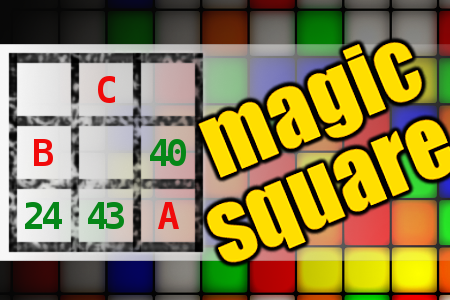
[4952] MAGIC SQUARE: Calculate A-B-C - The aim is to place the some numbers from the list (9, 10, 11, 12, 24, 25, 27, 40, 41, 43, 59, 74) into the empty squares and squares marked with A, B an C. Sum of each row and column should be equal. All the numbers of the magic square must be different. Find values for A, B, and C. Solution is A-B-C. - #brainteasers #math #magicsquare - Correct Answers: 20 - The first user who solved this task is Djordje Timotijevic
BRAIN TEASERS
enter your answer and press button OK

MAGIC SQUARE: Calculate A-B-C

The aim is to place the some numbers from the list (9, 10, 11, 12, 24, 25, 27, 40, 41, 43, 59, 74) into the empty squares and squares marked with A, B an C. Sum of each row and column should be equal. All the numbers of the magic square must be different. Find values for A, B, and C. Solution is A-B-C.
Correct answers: 20
The first user who solved this task is Djordje Timotijevic.
#brainteasers #math #magicsquare
Register with your Google Account and start collecting points.
Check your ranking on list.

I will grant you three wishes . . . maybe!?

An older couple were walking on a beach when the husband tripped over a bottle and a genie came out.

“You can each have one wish,” said the genie. The wife made her wish first “I would like to travel around the world, with my husband,”.

Suddenly there appeared in her hand two tickets for travel around the world.

Now it was the husbands turn, “Well” said the husband, with a naughty look on his face “I wish I can have a younger companion,” . The words were barely out of his mouth when poof,

he aged 20 years!

Found on https://throughopenlens.com , posted on June 22, 2015 by Lukas Kondraciuk

Jokes of the day - Daily updated jokes. New jokes every day.
Follow Brain Teasers on social networks

Brain Teasers

puzzles, riddles, mathematical problems, mastermind, cinemania...

L.L. Zamenhof

Died 14 Apr 1917 at age 57 (born 15 Dec 1859).Dr. Lazarus Ludwig Zamenhof was a Polish physician and oculist who created the most important of the international artificial languages - Esperanto. He believed everybody in the world should be able to communicate with each other by means of a single international language, so he developed Esperanto, meaning "he who hopes." It was introduced in a pamphlet he published in 1887. Esperanto vocabulary is comprised primarily of words with Latin roots and words common to several languages. Esperanto is less complicated than an earlier attempt at artificial language called Volapuk. While Esperanto associations formed around the world, it never became widely accepted.
This site uses cookies to store information on your computer. Some are essential to help the site properly. Others give us insight into how the site is used and help us to optimize the user experience. See our privacy policy.