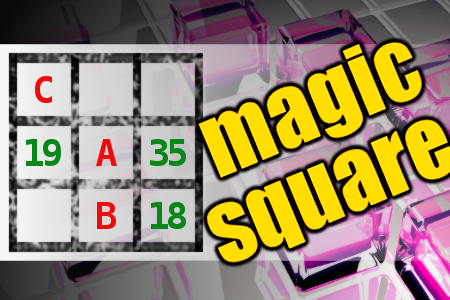
MAGIC SQUARE: Calculate A+B+C
[5157] MAGIC SQUARE: Calculate A+B+C - The aim is to place the some numbers from the list (15, 18, 19, 21, 24, 25, 35, 38, 39, 67, 79, 97) into the empty squares and squares marked with A, B an C. Sum of each row and column should be equal. All the numbers of the magic square must be different. Find values for A, B, and C. Solution is A+B+C. - #brainteasers #math #magicsquare - Correct Answers: 21 - The first user who solved this task is Djordje Timotijevic
BRAIN TEASERS
enter your answer and press button OK

MAGIC SQUARE: Calculate A+B+C

The aim is to place the some numbers from the list (15, 18, 19, 21, 24, 25, 35, 38, 39, 67, 79, 97) into the empty squares and squares marked with A, B an C. Sum of each row and column should be equal. All the numbers of the magic square must be different. Find values for A, B, and C. Solution is A+B+C.
Correct answers: 21
The first user who solved this task is Djordje Timotijevic.
#brainteasers #math #magicsquare
Register with your Google Account and start collecting points.
Check your ranking on list.

The Unacceptable Tax Return

This example shows the importance of accuracy when submitting your tax return. The IRS returned the Tax Return submitted by a New York City man implying that he answered one of the questions incorrectly.

In response to the question, 'List your dependents”, you wrote: '12.1 million illegal immigrants, 1.1 million crack-heads, 4.4 million unemployed deadbeats, 80,000 criminals in over 85 prisons, at least 450 idiots in Congress and those who call themselves Politicians.' The IRS responded that “this is unacceptable!”

The man's response to the IRS was: 'Who did I leave out?'

Jokes of the day - Daily updated jokes. New jokes every day.
Follow Brain Teasers on social networks

Brain Teasers

puzzles, riddles, mathematical problems, mastermind, cinemania...

Electron

In 1897, at the Royal Institution Friday Evening Discourse, Joseph John Thomson (1856-1940) first announced the existence of electrons (as they are now named). Thomson told his audience that earlier in the year, he had made a surprising discovery. He had found a particle of matter a thousand times smaller than the atom. He called it a corpuscle, meaning "small body." Although Thomson was director of the Cavendish Laboratory at the University of Cambridge, and one of the most respected scientists in Great Britain, the scientists present found the news hard to believe. They thought the atom was the smallest and indivisible part of matter that could exist. Nevertheless, the electron was the first elementary particle to be discovered.
This site uses cookies to store information on your computer. Some are essential to help the site properly. Others give us insight into how the site is used and help us to optimize the user experience. See our privacy policy.