
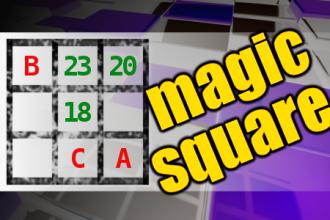
MAGIC SQUARE: Calculate A-B*C
[5740] MAGIC SQUARE: Calculate A-B*C - The aim is to place the some numbers from the list (6, 7, 9, 17, 18, 20, 23, 24, 26, 30, 73) into the empty squares and squares marked with A, B an C. Sum of each row and column should be equal. All the numbers of the magic square must be different. Find values for A, B, and C. Solution is A-B*C. - #brainteasers #math #magicsquare - Correct Answers: 17 - The first user who solved this task is Djordje Timotijevic
BRAIN TEASERS
enter your answer and press button OK

MAGIC SQUARE: Calculate A-B*C

The aim is to place the some numbers from the list (6, 7, 9, 17, 18, 20, 23, 24, 26, 30, 73) into the empty squares and squares marked with A, B an C. Sum of each row and column should be equal. All the numbers of the magic square must be different. Find values for A, B, and C. Solution is A-B*C.
Correct answers: 17
The first user who solved this task is Djordje Timotijevic.
#brainteasers #math #magicsquare
Register with your Google Account and start collecting points.
Check your ranking on list.

Blind Man

Husband and wife are waiting at the bus stop with their nine children. A blind man joins them after a few minutes. When the bus arrives, they find it overloaded and only the wife and the nine kids are able to fit onto the bus.
So the husband and the blind man decide to walk. After a while, the husband gets irritated by the ticking of the stick of the blind man as he taps it on the sidewalk, and says to him, "Why don't you put a piece of rubber at the end of your stick? That ticking sound is driving me crazy."
The blind man replies, "If you would've put a rubber at the end of YOUR stick, we'd be riding the bus ... so shut up."  

Jokes of the day - Daily updated jokes. New jokes every day.
Follow Brain Teasers on social networks

Brain Teasers

puzzles, riddles, mathematical problems, mastermind, cinemania...

Joseph Paxson Iddings

Born 21 Jan 1857; died 8 Sep 1920 at age 63.American geologist who advanced understanding in the field of petrology - the study of the origin, composition, structure, and alteration of rocks. Around 1880, he was one of the first in the U.S. to study thin rock sections with a microscope. He explored and mapped the geology of Yellowstone National Park during seven field seasons (1883-1890). From this study he introduced original ideas concerning the range of crystal line textures and mineral composition of granular igneous rocks. He proposed that physical and chemical conditions causing differences in the formationof neighbouring igneous rock from the same igneous magma. Further, he rejected the prevailing view that granular rocks were only formed in large masses at depth.«
This site uses cookies to store information on your computer. Some are essential to help the site properly. Others give us insight into how the site is used and help us to optimize the user experience. See our privacy policy.