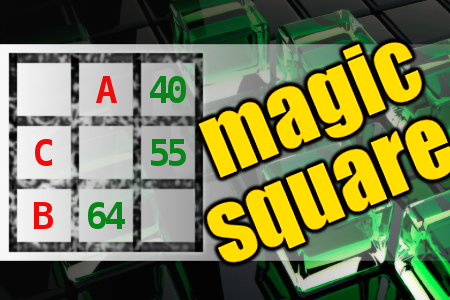
MAGIC SQUARE: Calculate A*B*C
[5784] MAGIC SQUARE: Calculate A*B*C - The aim is to place the some numbers from the list (10, 14, 19, 31, 35, 40, 50, 55, 59, 64, 90, 91) into the empty squares and squares marked with A, B an C. Sum of each row and column should be equal. All the numbers of the magic square must be different. Find values for A, B, and C. Solution is A*B*C. - #brainteasers #math #magicsquare - Correct Answers: 18 - The first user who solved this task is Nílton Corrêa De Sousa
BRAIN TEASERS
enter your answer and press button OK

MAGIC SQUARE: Calculate A*B*C

The aim is to place the some numbers from the list (10, 14, 19, 31, 35, 40, 50, 55, 59, 64, 90, 91) into the empty squares and squares marked with A, B an C. Sum of each row and column should be equal. All the numbers of the magic square must be different. Find values for A, B, and C. Solution is A*B*C.
Correct answers: 18
The first user who solved this task is Nílton Corrêa De Sousa.
#brainteasers #math #magicsquare
Register with your Google Account and start collecting points.
Check your ranking on list.

Lewis Black: Absolute Faith

You cant deny the faith of these people that we fight: its absolute. They believe that if they kill themselves, theyll be met in heaven with 70-some-odd virgins. Imagine that kind of faith -- to think that that would happen, when I havent met one on earth.
Jokes of the day - Daily updated jokes. New jokes every day.
Follow Brain Teasers on social networks

Brain Teasers

puzzles, riddles, mathematical problems, mastermind, cinemania...

Edmund Cartwright

Born 24 Apr 1743; died 30 Oct 1823 at age 80.In 1784, Cartwright visited a factory owned by Richard Arkwright. Inspired by what he saw, he began working on a machine that would improve the speed and quality of weaving. With the help of a blacksmith and a carpenter, Cartwright produced his power loom, which he patented (1785). The invention revolutionised weaving, changing it from a manual process into a mechanical one. By 1787, he opened a weaving mill in Doncaster. Two years later, he powered his looms with steam engines produced by James Watt and Matthew Boulton. He also invented a machine for combing wool. In 1793 his business failed but parliament recognized his achievements in 1809 with an award of £10,000.
This site uses cookies to store information on your computer. Some are essential to help the site properly. Others give us insight into how the site is used and help us to optimize the user experience. See our privacy policy.